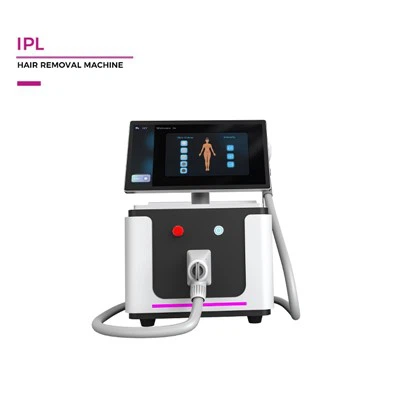




When it comes to hair removal, many people have had the experience of "repeated attempts." Shaving with a razor results in the hair growing back in two or three days, with new stubble that's stiff and prickly; hair removal creams have a pungent chemical smell and can easily cause redness on sensitive skin; waxing can last a little longer, but the painful tug-of-war is something you'd never want to do again. The biggest problem with these traditional methods is that they only treat the symptoms, not the root cause.
In recent years, IPL (Intense Pulsed Light) hair removal has gained increasing attention. It claims to inhibit hair growth from the root, restoring smooth skin. So, what is the real effect of IPL hair removal? Is there really a significant change before and after IPL treatment? Read this article to learn more about the real changes brought about by IPL hair removal and the factors that influence these changes.
When people search for IPL hair removal before and after results, dramatic side-by-side photos can make the process look almost instantaneous.
The reality is more gradual.
After one IPL treatment, you should not expect all visible hair to disappear immediately. IPL works progressively across repeated sessions because hair follicles are at different stages of the growth cycle. As treatment continues, successful results may appear as lower hair density, slower or patchier regrowth, and fewer visible terminal hairs.
Clinical studies support meaningful hair reduction from IPL, but there is no universal percentage or timeline that applies to everyone. Results depend on the IPL device, treatment protocol, body area, hair characteristics, skin characteristics and number of sessions.(Authoritative Source: https://pubmed.ncbi.nlm.nih.gov/11074695/)
IPL Hair Removal Before and After: Quick Overview
| Stage | What You May Notice |
|---|---|
| Before treatment | Normal hair density and regrowth pattern |
| After 1 treatment | Limited visible change; treated hairs may shed gradually |
| After several treatments | Increasingly patchy or reduced regrowth |
| After a treatment course | More substantial reduction in visible hair density |
| Long-term | Results may persist, but some regrowth can occur |
| Maintenance | Additional treatments may be appropriate when noticeable regrowth returns |
The important point is that IPL before and after results should be judged across a treatment course-not immediately after a single session.
The Scientific Principles Before Hair Removal
Before delving into the effects, we must understand its basic principles. IPL (Intense Pulsed Light) is not a laser, but a broad-spectrum light source that emits a wide range of light (approximately 400-1200nm). A filter selects the wavelengths effective for hair removal. Its target is the melanin in the hair follicle.
Selective photothermolysis: The melanin in the hair follicle and hair shaft preferentially absorbs specific wavelengths of light energy. This light energy is rapidly converted into heat energy, raising the local temperature to over 70°C within milliseconds. This precisely destroys the hair follicle's growth site while minimizing damage to the surrounding skin. Damaged hair follicles enter a dormant or atrophied state, preventing normal hair growth. This explains one of the most noticeable characteristics of IPL hair removal before and after results: hair reduction develops over multiple sessions rather than appearing all at once.
IPL Hair Removal Results Timeline
Before IPL Hair Removal
Before beginning treatment, it is useful to document the baseline condition of the treatment area. For a meaningful before-and-after comparison, keep the following as consistent as possible:
- Treatment area
- Camera angle
- Lighting
- Time since shaving
- Distance from the camera
- Treatment interval
This is particularly important for clinics documenting IPL results because differences in shaving, lighting or photography can make a result look much stronger-or weaker-than it actually is.
A true IPL before and after comparison should show changes in hair growth under reasonably comparable conditions.
IPL Before and After One Treatment
After one IPL session, dramatic hair clearance should not be expected.
Some treated hairs may remain visible initially and then shed gradually. Other follicles may not have been in an optimal growth stage when the treatment was performed.
Therefore, IPL before and after one treatment may show relatively little visual difference.
That does not necessarily indicate treatment failure.
A single treatment represents only one point in a longer hair-growth cycle.
Clinical research also supports the importance of repeated treatments. In one study of Chinese patients, average hair reduction increased from 49.9% after one treatment to 83.8% after four treatments, although the authors emphasized that efficacy varied by anatomical location and that longer-term study was still needed.(Authoritative Source: https://pubmed.ncbi.nlm.nih.gov/19337941/)
That study should not be interpreted as a promise that every patient will achieve the same percentages. Instead, it illustrates why multiple sessions can produce progressively different results.
IPL Hair Removal Before and After Several Treatments
As additional treatments are completed, changes can become easier to observe. Instead of expecting every hair to disappear simultaneously, look for patterns such as:
-
Reduced density
Fewer visible hairs may return within the treated area.
-
Patchier regrowth
Some areas may respond more quickly than others.
-
Longer periods between noticeable regrowth
Hair may become less visually prominent between treatments.
-
Changes in the visible hair population
Coarse terminal hairs may become less numerous as treatment progresses.
Uneven results during a treatment course are not unusual because different follicles are moving through different growth stages. This is why consistent treatment protocols are important when evaluating IPL results.
What Do Clinical Studies Show About IPL Before and After Results?
Before-and-after photographs are useful, but they are much more meaningful when combined with measured hair-count data. Several published studies provide useful context.
Multiple-Treatment IPL Study
A prospective study involving 34 patients reported a mean 76% hair removal efficiency after an average of 3.7 treatments. More than 94% of treated sites achieved mean hair-removal efficiency greater than 50%.(Authoritative Source: https://pubmed.ncbi.nlm.nih.gov/11074695/)
Four-Treatment Study
In another study, average hair reduction across treatment sites progressed from:
49.9% after one treatment → 58.6% after two → 79.3% after three → 83.8% after four.
However, outcomes differed between anatomical areas, and the authors noted that further research was required to establish long-term efficacy.(Authoritative Source: https://pubmed.ncbi.nlm.nih.gov/19337941/)
Longer-Term Follow-Up
A study of 70 female patients who underwent an average of eight IPL treatments reported 87% hair removal over a mean follow-up period of 27.3 months.(Authoritative Source: https://pubmed.ncbi.nlm.nih.gov/14756645/)
Other research has also demonstrated persistent hair reduction months after IPL treatment. For example, a small home-use IPL study involving ten subjects reported an 87% reduction in terminal hair count six months after the fourth treatment.(Authoritative Source: https://pubmed.ncbi.nlm.nih.gov/23331874/)
What Does This Mean for Your Own Before-and-After Results?
It does not mean that IPL guarantees 76%, 83%, or 87% hair reduction.
These studies used different devices, subjects, body areas, treatment protocols and follow-up periods.
The evidence instead supports a more useful conclusion:
IPL can produce substantial and persistent hair reduction, but the amount and speed of improvement vary considerably.
Normal post-treatment phenomena
Mild redness, swelling, and a burning sensation may occur at the treatment site. This is a normal reaction to the photothermal effect and usually subsides on its own within a few hours to 1-2 days.
Post-treatment care points
Avoid hot baths, saunas, swimming, and strenuous exercise for 24-48 hours to prevent skin irritation.
Strict sun protection is essential. When going out, apply sunscreen with SPF 30 or higher, or use physical sun protection methods such as umbrellas and wide-brimmed hats, and maintain this for at least one month.
Discontinue use of antiperspirants, exfoliating products, and irritating skincare products.

IPL Hair Removal Before and After: At-Home vs. Professional
During a survey of social media platforms popular with young people, such as Reddit and YouTube, we found that many struggle to choose between at-home IPL devices and professional-grade IPL equipment. To provide an objective perspective, we offer the following analysis:
Power Difference
Most at home ipl hair removal before and after success stories highlight convenience and cost-savings. For many, handheld devices are the ideal choice for experiencing phototherapy hair removal. However, for those seeking "clinical-grade" results, at-home devices often fall short.
For safety reasons, the power of at-home devices is typically limited (generally 3-6 J/cm²). In contrast, professional devices used in clinics can achieve much higher energy levels (some advanced systems can reach 20-50 J/cm²) and are equipped with integrated cooling systems to protect the epidermis. This means that professional IPL laser hair removal usually requires only 6 sessions to achieve the desired results, while at-home devices may require 12 to 20 sessions to achieve similar results.
Research has demonstrated meaningful hair reduction with both professional and home-use IPL systems, so comparisons should be based on the actual device and protocol rather than assuming one fixed percentage for either category.(Authoritative Source: https://pubmed.ncbi.nlm.nih.gov/11074695/ )
For Professional Clinics
Professional buyers should evaluate factors such as:
- Available wavelength/filter configuration
- Fluence and pulse adjustment
- Spot size
- Cooling system
- Treatment speed
- Skin and hair assessment
- Device reliability
- Training and treatment protocols
【Want to learn more about professional, clinic-grade IPL equipment? Please click here: Professional IPL Hair Removal & Skin Rejuvenation Solutions 】
Real-world case study
A real user shared her experience with bikini line hair removal on social media: she tried waxing but developed folliculitis, then bought a home hair removal device and used it three times, finding it "completely ineffective." Later, she used medical-grade equipment at a professional hair removal clinic, and the results were significantly improved after the third treatment.
This case illustrates that insufficient energy is the most fundamental difference between home and medical devices. Furthermore, actual testing showed that on the same person, comparing professional IPL devices and home devices, after 12 days, almost all hair shafts on the professional device side had fallen off, while almost none on the home device side.
The Role of Home Devices
We shouldn't underestimate the importance of home IPL devices; they play a crucial role in the "maintenance" phase. After completing a full professional IPL treatment, using home devices for occasional maintenance is a good decision. However, for the initial, thorough hair removal phase, professional systems offer deeper penetration and more lasting follicle destruction, resulting in a higher return on investment.
These are some photos which taking professional IPL hair removal before and after


How to Take Reliable IPL Before and After Photos
For clinics, salons and users documenting IPL results, consistent photography makes before-and-after evidence much more meaningful. Use the same:
- Lighting - avoid making the "after" image artificially brighter.
- Camera angle - photograph the same area from approximately the same position.
- Camera distance - changes in magnification can exaggerate differences in hair density.
- Hair-growth interval - do not compare a freshly shaved "after" image with a fully grown "before" image.
- Skin condition - avoid using temporary post-treatment redness as evidence of effectiveness.
- Treatment area - mark or document the same anatomical area where possible.
For stronger clinical documentation, combine photographs with hair counts or standardized treatment records rather than relying on appearance alone.
IPL Hair Removal Before and After by Body Area
| Differences in effects on different parts
| Treatment Area | What to Consider |
|---|---|
| Underarms | Often contains relatively coarse, pigmented hair that can provide a distinct IPL target |
| Legs | Large treatment area; changes in overall hair density can be easier to observe |
| Bikini Area | Hair may be coarse and dense, but appropriate parameters and skin assessment remain important |
| Arms | Hair thickness and pigmentation can vary considerably |
| Upper Lip / Face | Facial hair patterns and growth cycles differ from many body areas |
| Chin | Results can be influenced by individual hair characteristics and underlying growth patterns |
A systematic review of long-term laser and light-based hair reduction found that outcomes differed according to anatomical site, with hair-growth cycles being one factor that may contribute to these differences.(Authoritative Source: https://pubmed.ncbi.nlm.nih.gov/35634805/)
Therefore, avoid using a dramatic leg or underarm IPL before and after photo as a universal prediction for facial hair-or vice versa.
What Affects IPL Hair Removal Before and After Results?
1. Hair Color and Pigment
IPL relies on melanin as an optical target.
Dark, pigmented hair generally provides a stronger target than hair with very little melanin. White, gray and some very light hair may therefore respond poorly to conventional IPL hair-removal systems.
2. Skin Characteristics
Skin also contains melanin, so appropriate parameters and treatment suitability depend partly on the relationship between skin pigmentation and hair pigmentation.
Professional assessment becomes particularly important when treating a broader range of skin types.
3. Hair Growth Cycle
Only a portion of the hair population is optimally positioned for treatment during a particular session.
This is one of the main reasons repeated treatments are necessary.
4. Number and Consistency of Treatments
A single session and a complete treatment course should not be expected to produce the same result.
Research repeatedly demonstrates that hair reduction can develop across successive sessions.(Authoritative Source: https://pubmed.ncbi.nlm.nih.gov/11074695/)
5. IPL Device and Treatment Parameters
Not every IPL machine delivers light in exactly the same way.
Filters, fluence, pulse characteristics, contact cooling and treatment protocol can all influence treatment delivery.
For professional clinics, therefore, the quality and configurability of the IPL platform matter alongside operator technique.
Common IPL Before and After Misconceptions
❌ "Permanent hair removal in one session"
✅ Multiple treatments are required, following a course of treatments. IPL treatment can help you achieve long-term hair reduction.
❌ "IPL is completely painless"
✅ There may be a slight tingling sensation, within the tolerance range for most people.
❌ "Hair removal will affect sweating"
✅ Hair follicles and sweat glands are two independent structures. IPL targets the melanin in the hair follicle and will not affect the function of sweat glands.
❌ "Everyone should achieve 80–90% hair reduction."
✅ No. Percentages reported in individual studies apply to those particular study populations, devices and protocols and should not be treated as universal guarantees.(Authoritative Source: https://pubmed.ncbi.nlm.nih.gov/11074695/)
❌ "IPL hair removal is suitable for all skin types and hair colors"
✅ The effects are limited and may even be risky for people with light hair or dark skin. It is essential to choose a qualified IPL device and have the treatment performed by a physician with extensive clinical experience.

Is IPL hair removal worth trying?
The evidence for ipl hair removal before and after is overwhelming when the technology is used correctly. While at home ipl hair removal before and after results offer a convenient lifestyle choice, they often represent a compromise in speed and total hair eradication compared to clinical treatments. For businesses and individuals prioritizing results and long-term ROI, investing in professional-grade IPL technology remains the gold standard for achieving that permanent, silk-smooth finish.
If you'd like to introduce professional IPL hair removal equipment to your clinic or beauty salon, feel free to contact us.
IPL Hair Removal Before and After: The Bottom Line
IPL hair removal before and after results are usually progressive rather than immediate.
After one treatment, the visual difference may be limited. As multiple sessions target suitable hairs across successive growth cycles, users may begin to see reduced density, patchier regrowth and fewer visible hairs.
Published clinical research supports the ability of IPL to achieve substantial hair reduction, including persistent results at longer follow-up periods. However, the exact result varies according to the device, treatment protocol, body area and individual hair and skin characteristics.
For that reason, the most trustworthy IPL before and after results are not simply the most dramatic photos.
They are results documented with:
consistent photography + treatment history + follow-up period + appropriate clinical context.
FAQ
Q: How soon can you see IPL hair removal results?
A: Some changes may become noticeable after early treatments, but meaningful hair reduction should generally be evaluated across multiple sessions rather than immediately after one treatment.
Q: What does IPL hair removal look like after one treatment?
A: The difference may initially be modest. Some treated hairs may shed gradually, while other follicles continue through their normal growth cycle.
Q: How many IPL sessions before you see a difference?
A: There is no universal number. Clinical studies show progressively increasing hair reduction across repeated treatments, but the response varies by device, body area and individual characteristics.
Q: Can IPL remove 100% of hair?
A: IPL should not be presented as guaranteeing complete elimination of every hair. A more appropriate expectation is substantial, long-term hair reduction.
Q: Does IPL hair grow back?
A: Some hair can regrow after IPL. The amount, timing and appearance of regrowth vary, and maintenance treatments may sometimes be used.
Q: Why do IPL before and after results vary so much?
A: Hair pigmentation, skin characteristics, body area, hair-growth cycle, device technology, treatment parameters and treatment consistency can all influence the final result.
Q: Are IPL before and after photos reliable?
A: They can be useful when photography conditions and treatment history are documented. Images taken with different lighting, shaving status, angles or follow-up intervals can be misleading.
References
1. Sadick NS, et al. Long-term photoepilation using a broad-spectrum intense pulsed light source. Archives of Dermatology.
2.Trelles MA, Ash C, Town G. Clinical and microscopic evaluation of long-term (6 months) epilation effects of a home-use IPL device. Journal of the European Academy of Dermatology and Venereology.
3.Hair reduction using intense pulsed light source - long-term follow-up of 70 patients.
4.Hair removal using a new intense pulsed light source in Chinese patients.
5.Efficacy of lasers and light sources in long-term hair reduction: a systematic review.
Explore More Professional Resources >>
Want to learn more about IPL technology? explore our expert buying guides and educational resources: