




Introduction
Laser hair removal is increasingly popular, not only for its rapid results but also for its long-lasting smoothness, eliminating the hassle of repeated shaving or waxing. Among the many laser hair removal methods, diode lasers and Alexandrite lasers are the most common. Many people are confused about which laser to choose. Below, we'll explain the differences between the two in terms of effectiveness, safety, and cost.
In this guide, we compare Alexandrite Laser and diode laser technologies from both a clinical and business perspective to help modern clinics make informed purchasing decisions.
Evidence Summary: What Clinical Studies Actually Show
Published clinical evidence supports both 755 nm alexandrite and approximately 800–810 nm diode lasers for long-term hair reduction. Head-to-head studies do not show that one platform is universally superior: outcomes vary with skin phototype, hair characteristics, treatment area, fluence, pulse duration, spot size, cooling and the number of sessions. The figures below describe specific study populations and protocols and should not be interpreted as guaranteed outcomes for every patient.
Technology Deep Analysis: Comparison of Basic Principles
To understand the difference between diode lasers and Alexandrite lasers, we must first understand their working principles. Different laser wavelengths determine the energy penetration depth and melanin absorption rate, which directly impacts hair removal effectiveness and safety.
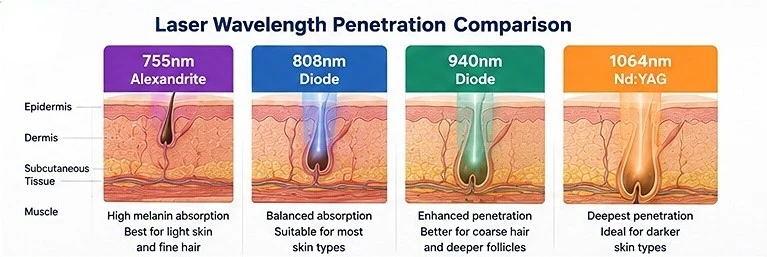
• Diode lasers have a wavelength of approximately 810nm, which allows them to penetrate deeper into the skin. They are more suitable for treating deep follicles and coarse hair, placing a greater emphasis on "depth."
• Alexandrite lasers have a shorter wavelength of 755nm, which allows for greater absorption of melanin. They are often more effective on fair skin and fine hair, and prioritize "precision."
A computational skin-model study compared the transmission of 810 nm diode and 755 nm alexandrite laser energy under the same modeled conditions. At a skin depth of 0.67 mm, the transmission ratios for the 810 nm diode laser were 36% and 27.5% in the two modeled skin samples, compared with 32% and 25% for the 755 nm alexandrite laser. At 1.32 mm, the corresponding diode values were 17% and 14.5%, compared with 13.5% and 11% for alexandrite. The authors concluded that the 810 nm diode wavelength penetrated deeper into the modeled dermis.
Source: Mustafa FH, Jaafar MS, Ismail AH, Mutter KN. 2014. Computational comparative skin-model study. Comparison of Alexandrite and Diode Lasers for Hair Removal in Dark and Medium Skin: Which is Better? Journal of Lasers in Medical Sciences.
What Is Alexandrite Laser?
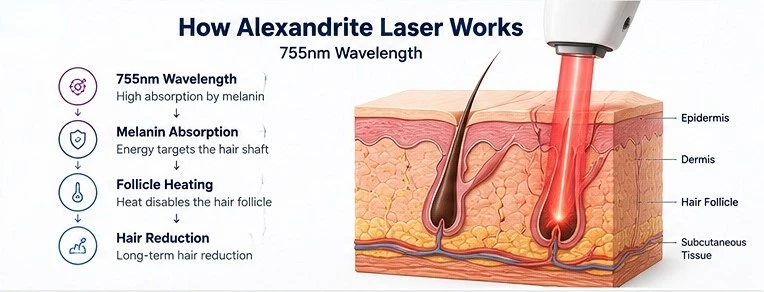
Alexandrite laser systems operate at a wavelength of 755nm, which has a very high absorption rate in melanin. Because of this characteristic, Alexandrite lasers are highly effective for:
- Fine hair
- Light skin tones
- Fast treatment sessions
- High-contrast hair-to-skin combinations
The strong melanin absorption allows energy to be concentrated directly into the hair follicle, often producing excellent results in fewer treatment sessions. Many premium laser platforms utilize Alexandrite technology, particularly in dermatology clinics and high-end aesthetic practices.
Clinics researching Alexandrite systems often evaluate premium platforms discussed in our Candela GentleMax Pro Cost & Review, one of the industry's most recognized Alexandrite-based laser solutions.
Advantages of Alexandrite Laser
High melanin absorption
Effective for fine hair
Fast treatment speed
Strong clinical reputation
Limitations of Alexandrite Laser
Less suitable for darker skin types
Higher risk of epidermal heating
Requires effective cooling systems
Typically carries a higher equipment investment
Diode laser systems typically operate at 808nm, although modern platforms increasingly combine multiple wavelengths to improve treatment versatility. Unlike Alexandrite lasers, diode lasers provide a more balanced relationship between melanin absorption and penetration depth. This makes diode technology particularly suitable for:
- Multiple skin types
- Coarse hair
- Deep follicles
- Large treatment areas
Modern diode systems often incorporate advanced cooling technologies and high-frequency treatment modes to improve patient comfort. One of the most recognized diode laser platforms is the Soprano Ice Titanium, which combines SHR treatment concepts with multiple wavelengths to create a comfortable treatment experience.
Clinics evaluating diode laser systems frequently compare technologies discussed in our Soprano Ice Titanium Laser Price & Cost: A Buyer's Guide for Modern Clinics.
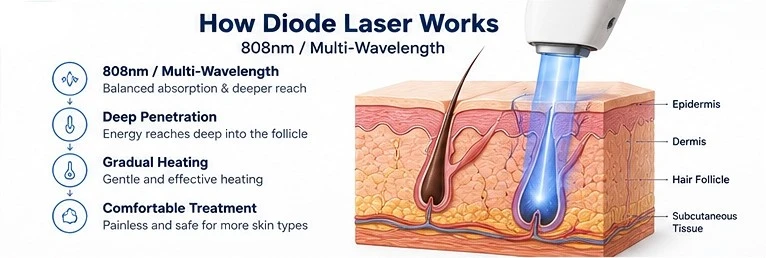
Advantages of Diode Laser
Suitable for a wider range of skin types
Excellent penetration depth
Comfortable treatment experience
Strong scalability for high-volume clinics
Limitations of Diode Laser
May require additional sessions for some fine hair types
Clinical outcomes depend heavily on cooling and energy stability
Performance varies significantly between manufacturer
A clinical study of 20 male patients evaluated 810 nm diode hair removal on large trunk areas, including the chest and back. Participants received four treatments at 40-day intervals. Mean hair reduction in the treated areas was 80.6% ± 2.8%. Treatment was generally well tolerated, with a mean pain score of 4.1 ± 0.8 on a 0–9 visual analogue scale. Slight redness lasting up to 24 hours was observed, while no mild-to-serious adverse events were registered during the study.
Source: Cannarozzo G, Pennati BM, Zingoni T. 2024. Clinical study, n=20. Trunk hair removal treatment with diode laser 810 nm in men population. Dermatology Reports.
Diode Laser vs Alexandrite Laser: Key Differences
Although both technologies are designed for long-term hair reduction, their clinical behavior differs considerably.
| Factor | Alexandrite Laser | Diode Laser |
|---|---|---|
| Primary Wavelength | 755nm | 808nm (or multi-wavelength) |
| Melanin Absorption | Very High | Moderate |
| Penetration Depth | Moderate | Deeper |
| Fine Hair Treatment | Excellent | Good |
| Coarse Hair Treatment | Good | Excellent |
| Skin Type Compatibility | Best for I–III | Suitable for I–VI |
| Treatment Comfort | Moderate | Higher with cooling |
| Popular Applications | Dermatology Clinics | Medical Spas & Aesthetic Clinics |
| Equipment Cost | Premium | Flexible |
| OEM Availability | Limited | Common |
Choosing the right technology is not only about treatment results-it also depends on your clinic's target patients, budget, and business model. While this article compares diode and Alexandrite lasers, many clinic owners also evaluate IPL systems when planning new service offerings. Understanding all three technologies helps make a better investment decision.
Continue Reading → Diode Laser vs IPL: Which Technology Offers Better ROI for Clinics?
Effectiveness of Diode Laser Hair Removal vs Alexandrite Laser
In actual experience, the ultimate effect of hair removal is influenced by multiple factors:
skin color, hair thickness, hair growth cycle, and the wavelength and energy settings of the device used.
Skin Compatibility
Lasers of different wavelengths have varying affinities for melanin in the skin, which determines their suitability for different Fitzpatrick (I–VI) skin types.
• Diode lasers, due to their longer wavelengths and moderate absorption of epidermal melanin, can be used more safely on a range of skin tones, from light to dark.
• Alexandrite lasers, due to their strong absorption of melanin, generally perform best on skin tones I–III (lighter skin tones).
Hair Type
The density and shade of your hair directly impact the laser's targeting effectiveness.
• Coarse, dark hair contains more melanin and larger follicles, generally allowing for deeper penetration by diode lasers.
• For fine or light hair, the Alexandrite laser typically produces faster results on lighter skin tones.
Hair Removal Speed and Treatment Duration
• Alexandrite devices typically have a larger spot size and higher absorption efficiency, allowing them to cover a larger area and achieve faster treatment times for appropriate skin tones.
• Diodes cover a medium area, and treatment times are moderate, typically requiring 6–8 sessions for long-term results.
A 2022 systematic review identified only five randomized controlled trials, totaling 223 patients, with follow-up periods long enough to cover at least one complete hair-growth cycle at the treated body site. Across the included trials, reported average long-term hair reduction ranged from 35% to 84.25% for alexandrite lasers and from 32.5% to 69.2% for diode lasers. The greatest long-term reduction was reported in trials treating leg hair, while the lowest reduction was reported in trials treating facial hair. These figures are cross-study ranges rather than a head-to-head ranking because the treatment areas, protocols and follow-up periods differed among trials.
Source: Krasniqi A, et al. 2022. Systematic review of five randomized controlled trials, n=223. Efficacy of lasers and light sources in long-term hair reduction: a systematic review. Journal of Cosmetic and Laser Therapy.
Safety Comparison: Which One Has the Upper Hand?
Many people are actually more concerned about "whether it will damage the skin" when undergoing hair removal.
Safety is indeed a significant concern, as different lasers react differently to the skin.
Side Effects
• Diode laser: The risk of side effects is low. Most users experience only mild redness, swelling, or burning, which typically resolves within hours; in rare cases, small papules may develop around the hair follicles.
• Alexandrite laser: Its concentrated energy and strong absorption of melanin can lead to superficial burns, blisters, or hyperpigmentation if not used properly.
Skin Sensitivity
• Diode laser: Its strong penetration and gentle absorption into the epidermis make it more suitable for darker skin or those with recent tans, presenting a relatively low risk.
• Alexandrite laser: It is more suitable for lighter skin. Dark skin or tanned skin can be prone to burns or hyperpigmentation, so it is generally not the preferred choice.
Comfort
• Diode laser: Many devices are equipped with a cooling system, making the treatment relatively gentle and painless.
• Alexandrite laser: Its concentrated energy results in a more noticeable stinging sensation during treatment, and additional cooling is often required.
The American Academy of Dermatology states that common short-term effects of laser hair removal include discomfort, swelling and redness, usually lasting 1–3 days. Less common risks include blistering, infection, scarring and skin lightening or darkening. The AAD also warns that treatment performed by an inexperienced operator can cause burns, permanent pigment changes and scars.
According to the same AAD guidance, patients may expect approximately 10%–25% hair reduction after the first treatment, most patients require two to six treatments, and treatment intervals are commonly four to six weeks. Results vary according to hair color and thickness, treatment area, laser type and skin color. Some patients may also require maintenance treatments.
Source: American Academy of Dermatology. Laser hair removal: FAQs. AAD official guidance
Cost Comparison of Diode Laser Hair Removal and Alexandrite Laser
When choosing laser hair removal, price and time are equally important, influencing not only the client but also the beauty salon's investment decision.
Equipment Cost
• Diode laser: The initial price is higher, but the technology is stable, long-lasting, and long-term maintenance costs are low, resulting in a better overall return on investment.
• Alexandrite laser: The purchase cost may be lower, but some components require high maintenance, and long-term maintenance is frequent, potentially resulting in a higher total cost of ownership.
Cost Per Treatment & Total Treatments
The cost per treatment session varies depending on the treatment area, operator qualifications, and equipment. Generally, smaller areas (such as the underarms) cost less than larger areas (such as the legs or back).
• Diode laser: The cost per treatment session is slightly higher, but due to the moderate number of treatment sessions, the overall cost-effectiveness is good.
• Alexandrite laser: The cost per treatment session is relatively low, but more treatments may be required, resulting in a similar or even higher overall cost.
Return on Investment
• To reduce clinical risk and expand their potential clientele, institutions may choose diode models that cover a wider population.
• Institutions focused on markets with predominantly light-skinned clients may prefer alexandrite to optimize single-session efficiency.
Time Cost
• Diode laser: Moderate treatment intervals and a short downtime minimize disruption to daily life.
• Alexandrite laser: A single treatment is fast, but special sun protection is recommended post-procedure to prevent pigmentation issues.
From a business perspective, ROI often matters more than technology alone. Many clinic owners discover that the most technically advanced platform is not always the most profitable investment.
When evaluating laser equipment, clinics should consider:
- Initial acquisition cost
- Maintenance expenses
- Treatment speed
- Consumable costs
- Service support
- Equipment lifespan

Business Comparison
| Business Factor | Alexandrite Laser | Diode Laser |
|---|---|---|
| Initial Investment | Higher | More Flexible |
| Maintenance Cost | Medium to High | Lower |
| Treatment Throughput | High | Very High |
| Patient Coverage | Moderate | Broad |
| Scalability | Moderate | Excellent |
| Distributor Opportunities | Limited | Strong |
| OEM/Private Label Options | Rare | Common |
| ROI Potential | High | Very High |
For many modern clinics, diode platforms offer an attractive balance between performance, flexibility, and profitability. This is one reason why multi-wavelength diode systems continue gaining market share globally.
The available evidence supports several practical advantages of modern diode platforms. First, clinical studies have reported measurable hair reduction in Fitzpatrick III–VI populations when treatment parameters and cooling are selected appropriately. Second, low-fluence, high-repetition protocols can reduce treatment discomfort while maintaining substantial hair reduction. Third, scanning and in-motion delivery methods have been studied in axillary, facial, bikini, chest and back areas. Finally, multi-wavelength diode platforms have produced significant hair reduction in studies that included both lighter and darker phototypes.
These findings support the clinical versatility of the diode technology category, but they do not by themselves establish the performance, safety, patient throughput or return on investment of a specific commercial device. Product-level claims should be supported by that device's own specifications, regulatory documentation, output testing and post-market data.
Which Equipment Is Best Suited for Your Clinic?
Alexandrite (755nm)
Target demographic: Individuals with lighter skin tones (Fitzpatrick types I–III) who prioritize maximum speed and have a certain tolerance for pain.
Diode (808nm / Multi-wavelength)
Target audience: All skin tones (Fitzpatrick types I–VI); clients sensitive to pain, seeking cost-effectiveness, or requiring skin repair.
💡 Newangie Recommendation: If your clinic is located in a diverse community, a multi-wavelength diode laser is the recommended choice to maximize your client base and minimize operational risk.
Why More Clinics Are Choosing Multi-Wavelength Diode Platforms?
The newest generation of diode laser platforms combines multiple wavelengths into a single system.
Common configurations include:755nm,808nm,940nm,1064nm. This approach allows practitioners to customize treatments based on: Hair thickness, Hair depth, Skin type, Treatment area.
Many clinics are now moving toward multi-wavelength diode platforms because they provide:
- Greater treatment flexibility
- Broader patient coverage
- Comfortable treatment experiences
- Faster ROI potential
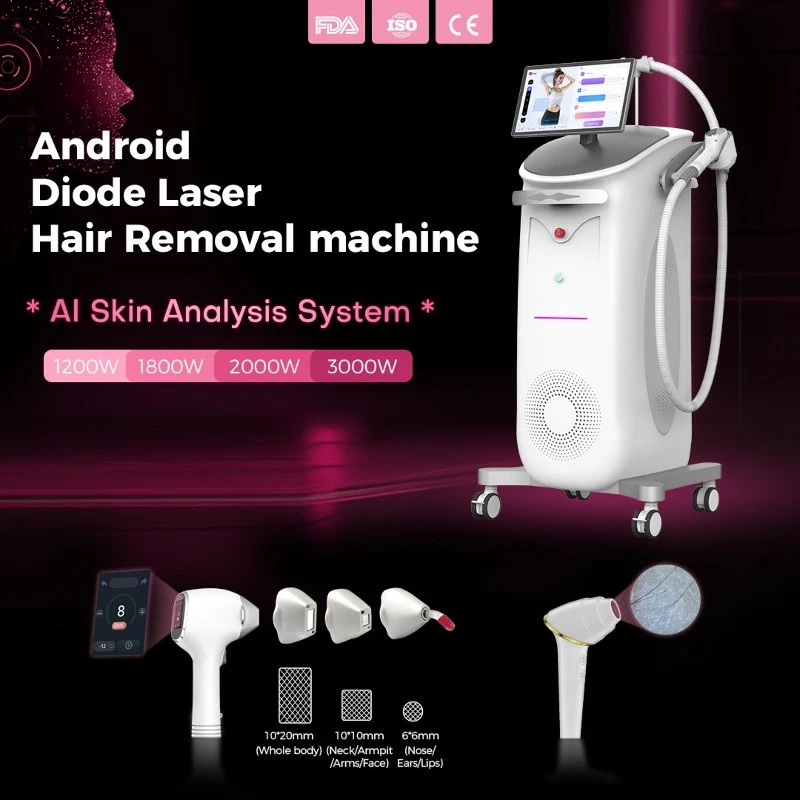
The NewAngie Diode Laser Therapy Series incorporates advanced multi-wavelength technology together with:
Up to 3000W configurable power
US Coherent laser bars
FAC beam shaping technology
Compressor + TEC dual cooling
Up to 50 million shots lifespan
Multiple magnetic spot size options
Learn more about Newangie
For clinics seeking a modern hair removal platform, multi-wavelength diode technology offers an attractive balance between clinical performance and long-term business value.
A prospective dual-center study evaluated a diode module combining 755, 810 and 1064 nm wavelengths in 36 participants across Fitzpatrick skin types I–VI. Participants received four treatments at six-week intervals on the axilla or bikini line and were assessed three months after the final session by three blinded evaluators. Mean hair reduction was 41.5% ± 19.4% in the axilla and 48.1% ± 20.9% in the bikini line. When analyzed by skin group, mean reduction was 45.5% ± 16.9% in Fitzpatrick I–IV and 40.3% ± 17.2% in Fitzpatrick V–VI. No serious adverse events were reported.
This single-arm study supports the potential of a simultaneous multi-wavelength diode approach to produce significant hair reduction in both lighter and darker phototypes.
Source: Gold MH, Weiss E, Biron J. 2023. Prospective dual-center single-arm study, n=36. Novel laser hair removal in all skin types. Journal of Cosmetic Dermatology.
Newangie: Your Trusted Supplier of Laser Beauty Equipment
As one of China's top laser hair removal suppliers, Newangie boasts 18 years of R&D and production experience. Our 6,000-square-meter factory, equipped with over 10 production lines, ensures a consistent supply of quality-compliant laser aesthetic devices. If you're looking for reliable laser aesthetic equipment, please contact us.
FAQ
Q: Is Alexandrite laser better than diode laser?
A: Not necessarily. Alexandrite lasers excel in treating fine hair and lighter skin tones, while diode lasers offer broader skin-type compatibility and greater treatment flexibility.
Q: Which technology is more comfortable?
A: Modern diode laser systems often provide a more comfortable treatment experience due to advanced cooling systems and SHR-style treatment methods.
Q: Which laser is better for clinics?
A: The answer depends on your business model. Clinics focused on premium dermatology services may prefer Alexandrite platforms, while medical spas and high-volume aesthetic clinics often benefit from diode laser systems.
Q: Why are multi-wavelength diode lasers becoming more popular?
A: Multi-wavelength systems combine versatility, broader patient coverage, comfortable treatments, and strong ROI potential, making them attractive for modern clinics and distributors.
Conclusion
Both diode lasers and Alexandrite lasers have their own advantages. Diode lasers are stable for coarse hair, various skin tones, and sensitive skin, offering a high safety profile and manageable long-term costs. Alexandrite lasers are quick and effective for fair skin and fine hair removal, but carry higher risks for patients with darker skin or those who perform the procedure improperly. Overall cost and the number of treatments are also important considerations. If you choose laser hair removal, the method should be tailored to your skin tone, hair characteristics, tolerance, and budget.
Current evidence supports long-term hair reduction with both alexandrite and diode lasers, but it does not establish either wavelength as universally superior. Clinical outcomes should be interpreted in the context of the specific patient, device and protocol, and no published percentage should be presented as a guaranteed individual result.
Related Resources Before You Buy
【Diode Laser vs IPL Laser】
【Candela GentleMax Pro Cost & Review】
【Soprano Ice Titanium Laser Price & Cost】
【Medical Grade Laser Hair Removal】
【Diode Laser 808nm Hair Removal】
【Professional Laser Hair Removal Machine Guide】
【Candela Alexandrite Laser: Features, Alternatives & Buying Guide For Professional Buyers】
【Is 755nm Alexandrite Laser Really Effective At Removing Hair?】
【Is Alexandrite Laser Better Than Nd:yag For Hair Removal?】


