




Laser tattoo removal is a gradual process. Most tattoos cannot be completely removed in a single session, as each laser treatment breaks down only a portion of the pigment; the body then requires time to naturally metabolize and clear away these pigment particles.
So, how many laser tattoo removal sessions are needed? how many treatments for laser tattoo removal? The exact number of treatments depends on the specific characteristics of the tattoo, the individual's skin condition, the laser technology employed, and how the body responds following each session.
This article provides a detailed explanation regarding the number of sessions required for laser tattoo removal, the factors that influence the total number of treatments, and the results patients can realistically expect.
Quick Answer: Average Number of Sessions Required for Laser Tattoo Removal
There is no one-size-fits-all standard for every tattoo, but the following ranges can serve as a general guide:
- Small, black-ink tattoos: Approximately 3 to 6 sessions
- Professional, black-ink tattoos: Approximately 6 to 10 sessions
- Large, professional tattoos: Approximately 8 to 12 sessions (or more)
- Multi-colored tattoos: Typically 8 to 12 sessions (or more)
- Fading a tattoo in preparation for a cover-up: Usually requires fewer sessions than complete removal
Even if two tattoos appear similar on the surface, the treatment outcomes can vary significantly; factors such as the depth and density of the ink, skin tone, the location of the tattoo on the body, and an individual's immune response all influence the final result.
Estimated Sessions by Tattoo Color
Tattoo color significantly influences the number of treatment sessions required for laser removal. Darker colors generally absorb laser energy more effectively, whereas lighter colors-or those with more complex compositions-often require more sessions and specific laser wavelengths.
| Tattoo Ink Color | Estimated Sessions Needed | Removal Difficulty | Notes |
| Black | 5-10 sessions | Usually easier | Black ink absorbs laser energy well and often responds better than other colors. |
| Dark blue / Dark gray | 6-10 sessions | Moderate | These colors often respond well, especially when the ink is not too dense. |
| Red / Orange | 6-12 sessions | Moderate | These colors may need a specific wavelength for better results. |
| Green | 8-12+ sessions | Difficult | Green ink can be stubborn and may require advanced multi-wavelength technology. |
| Light blue | 8-12+ sessions | Difficult | Light blue ink may respond slowly and often needs careful wavelength selection. |
| Yellow | 10+ sessions | Very difficult | Yellow ink absorbs laser energy poorly and may not clear completely in some cases. |
| White / Flesh tone | Variable; often difficult | Unpredictable | Some pigments may darken after laser exposure, especially in cosmetic tattoos. |
| Multicolor tattoo | 8-12+ sessions | Complex | Different colors fade at different speeds and may require multiple wavelengths. |
Estimated Sessions by Tattoo Size
The size of a tattoo also influences the treatment plan. Larger tattoos typically contain more ink and may require a longer total treatment duration.
| Tattoo Size | Common Examples | Estimated Sessions Needed | Notes |
| Extra small | Finger tattoo, tiny symbol, small initial | 3-6 sessions | Often faster to treat, but finger tattoos may fade slowly because of weaker circulation. |
| Small | Wrist tattoo, small name, simple line design | 4-8 sessions | Black and older small tattoos may clear faster than colorful or dense designs. |
| Medium | Forearm design, shoulder tattoo, palm-sized tattoo | 6-10 sessions | Results depend strongly on ink density and whether the tattoo is professional. |
| Large | Half sleeve, large back piece, thigh tattoo | 8-12+ sessions | May require section-by-section treatment and a longer total timeline. |
| Extra large | Full sleeve, full back, large multi-area tattoo | 10-15+ sessions | Often needs a long-term plan, especially if the tattoo is colorful or heavily saturated. |
NOTE:
For large-scale tattoos, the number of treatment sessions required may vary by specific area, rather than treating the entire tattoo all at once.
The practitioner may divide the tattoo into several sections for treatment, both to protect the skin and to enhance comfort.
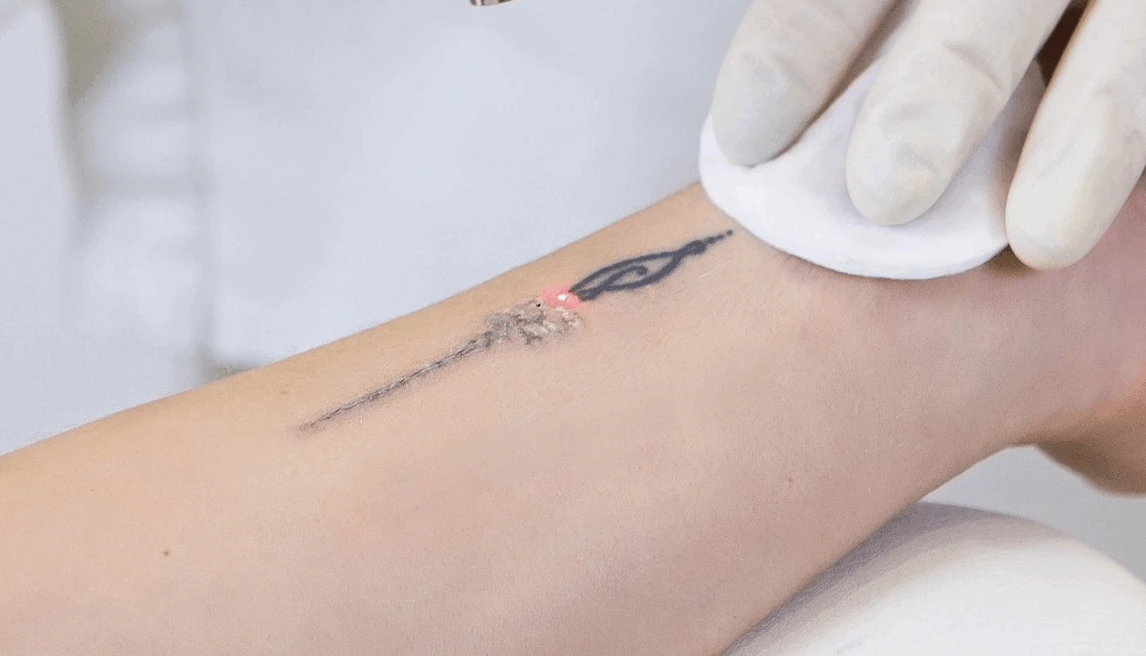
Laser tattoo removal works by using focused light energy to target the tattoo pigment within the skin. The tattoo ink absorbs the laser energy, heats up rapidly, and breaks down into smaller particles. Over time, the body's own immune and lymphatic systems gradually clear away these particles.
This is why a tattoo may continue to fade for several weeks following a single treatment session.
Why Multiple Sessions Are Required?
Tattoo ink resides deep within the dermis-the inner layer of the skin-making it impossible to remove completely and safely in one go. Each laser session can only target a portion of the pigment, and the skin requires time to heal itself between treatments.
Furthermore, ink that is located deeper or is more densely packed takes longer to break down fully.
Attempting to remove the ink too aggressively increases the risk of scarring or pigment changes. Therefore, to ensure safe and effective removal, the process is typically structured as a series of treatment sessions rather than a one-time procedure.
Key Factors Influencing the Number of Treatment Sessions
Tattoo Size
Generally, the larger the tattoo, the more treatment sessions are required, as it contains a greater quantity of pigment particles and covers a larger area of skin.
However, size is not the only determining factor. A small tattoo created with a high concentration of professional-grade black ink may be more difficult to remove, whereas a larger tattoo that has already begun to fade might respond to treatment more quickly.
Ink Color
- Black ink is typically the easiest to remove because it absorbs laser energy very effectively.
- Dark blue and dark gray tattoos also tend to respond well to treatment.
- Red and orange inks may require specific laser wavelengths for effective removal.
- Green, light blue, yellow, and white inks are generally more challenging to remove.
Multi-colored tattoos often require more treatment sessions, as different colors may necessitate the use of specific laser wavelengths and adjusted treatment parameters.
Age of the Tattoo
The older a tattoo is, the more likely it is to have faded. Over time, the body naturally breaks down some of the ink, even before laser treatment begins. This means there is a smaller total amount of pigment for the laser to target.
NOTE: For new tattoos, the skin must be completely healed before laser treatment can begin. Starting treatment too soon may exacerbate skin irritation and cause damage.
Ink Depth and Density
Professional tattoos are typically placed deeper in the skin, distributed more evenly, and often contain a higher concentration of ink. Consequently, they are generally more difficult to remove than many non-professional (amateur) tattoos.
Non-professional tattoos may be placed at a shallower depth or have a lower density, which can make them easier to fade. However, if the ink is deposited at uneven depths, it may result in inconsistent fading.
In general, the deeper the ink is embedded and the higher its density, the more treatment sessions will be required.
Skin Type and Skin Tone
Individuals with darker skin tones have higher levels of melanin in their skin, which can also absorb laser energy. To reduce the risk of burns, hyperpigmentation (darkening of the skin), or hypopigmentation (lightening of the skin), the practitioner may need to use more conservative treatment parameters, which in turn increases the number of sessions required.
However, this does not mean that individuals with darker skin tones cannot undergo laser tattoo removal; rather, it means that the treatment plan must be carefully adjusted. In some cases, safer settings may necessitate a greater number of treatment sessions.
Tattoo Location
Areas with better blood circulation generally clear tattoo ink more quickly. Tattoos located on the chest, back, shoulders, or upper arms often respond better to removal than those on the hands, fingers, ankles, or feet.
Laser Technology
The type of laser used influences treatment efficiency. Common tattoo removal technologies include Q-switched lasers and picosecond lasers.
Q-switched lasers have long been used for tattoo removal. Picosecond lasers deliver energy in shorter pulses, which helps break down certain ink particles into even finer fragments. For tattoos containing multiple colors, multi-wavelength laser systems are particularly effective.
NOTE: Technology alone is not enough. Achieving optimal treatment results also depends on selecting the correct wavelength, setting appropriate energy parameters, accurately assessing the condition of the skin, and the experience level of the practitioner.
How much time should be left between laser tattoo removal sessions?
In most cases, there should be an interval of 6 to 8 weeks between laser tattoo removal sessions. Some patients may require longer intervals-for instance, if the treated area is large, the skin reaction is particularly intense, or the tattooed area heals more slowly.
Undergoing treatments too frequently will not speed up the tattoo removal process, as the body still requires time to metabolize and eliminate the pigment.
If the intervals between sessions are too short, it will not improve the final outcome; instead, it may increase the risk of developing blisters, scarring, or pigmentary changes.
What to Expect After Each Treatment?
After the First Treatment
Following the initial session, the treated area may exhibit redness, swelling, warmth, minor blistering, or scabbing. These are normal post-treatment reactions that will subside quickly and should not interfere with your daily life or work.
Some tattoos may begin to fade early on, while others may show little to no change initially; this does not mean the treatment is ineffective. Typically, the fading becomes more noticeable after a few weeks.
After 3 to 5 Treatments
By this stage, many black tattoos or older tattoos will show more significant fading.
Lines may appear softer, and areas with dense ink saturation will begin to lighten. Different colors may fade at different rates.
After 6 to 10 Treatments
Following 6 to 10 sessions, many tattoos will show substantial fading.
Some tattoos may be nearly completely removed, while others may still have some residual pigment.
For larger, multi-colored, or densely inked tattoos, additional treatment sessions may be required.
How to Reduce the Number of Treatment Sessions Required?
Choose the Right Laser Technology
Clinics equipped with appropriate laser technology can match specific wavelengths to different tattoo ink colors.
For multi-colored tattoos, a multi-wavelength laser system may be essential; meanwhile, for certain types of tattoos, picosecond technology can be more effective at breaking down ink particles.
Follow Post-Treatment Care Instructions
Proper post-treatment care facilitates skin recovery and reduces the risk of complications. Patients should keep the treated area clean, avoid picking at scabs or blisters, and strictly follow professional guidance regarding the application of ointments, bandaging, and cleaning.
Improper care can delay healing and even increase the risk of scarring.
Avoid Sun Exposure
Sun exposure before or after treatment may increase the risk of pigmentation issues. Skin that is tanned or sunburned is often more sensitive to laser energy.
Patients should avoid exposing the treated area directly to sunlight and follow the sun protection measures recommended by their practitioner.
Maintain Healthy Lifestyle Habits
The human body plays a crucial role in clearing away the broken-down ink particles. Maintaining a healthy lifestyle-such as staying well-hydrated, getting sufficient sleep, exercising regularly, and quitting smoking-can help support this metabolic process.




Does laser tattoo removal hurt?
Laser tattoo removal may cause some mild discomfort. Following the procedure, the treated area might feel warm, swollen, or tender for a short time. Many people describe the sensation as being similar to a rubber band snapping against the skin-a level of discomfort that is generally manageable. Since a single treatment session for a small tattoo typically takes only a few minutes, this discomfort is usually short-lived.
High-end laser tattoo removal systems are often equipped with advanced cooling mechanisms to ensure both comfort and safety during the procedure. You may also use ice packs or topical anesthetic creams to help alleviate any discomfort.
The intensity of the pain depends on the location of the tattoo, an individual's personal sensitivity, and the specific settings used for the treatment.
Cost of Laser Tattoo Removal
The total cost of tattoo removal depends on the number of treatment sessions required, the size of the tattoo, the complexity of its colors, the clinic's location, and the specific laser technology employed.
A lower price for a single session does not necessarily mean a lower total cost. If the equipment used is ineffective or the treatment plan is poorly designed, a patient may end up needing more sessions.
Rather than simply seeking the lowest price, it is far more important to prioritize safety, professional expertise, and a scientifically sound, well-structured treatment plan.
FAQ
Q: Can a tattoo be completely removed in a single laser session?
A: Generally, no. A single session can only break down a portion of the ink. Since the body requires time to gradually metabolize the ink, most tattoos necessitate multiple sessions for complete removal.
Q: How many sessions are required for a small, black-ink tattoo?
A: A small, black-ink tattoo typically requires about 3 to 6 sessions. The exact number depends on factors such as the depth of the ink, the age of the tattoo, its location on the body, and how the skin responds to the treatment.
Q: How many sessions are required for a professional-grade tattoo?
A: Professional-grade tattoos usually require 6 to 12 sessions-or even more-because the ink is often deposited deeper, with greater density and more uniform distribution.
Q: What is the recommended interval between treatment sessions?
A: It is generally recommended to wait 6 to 8 weeks between sessions. Depending on how the skin heals and reacts, some individuals may require a longer interval.
Q: Can a tattoo be removed completely?
A: While some tattoos can be removed entirely, this is not guaranteed. The final outcome is influenced by factors such as the tattoo's colors, the depth of the ink, an individual's skin type, the specific laser technology used, and post-treatment care.
Q: Are picosecond lasers more effective for tattoo removal?
A: While picosecond lasers may break down certain ink particles more efficiently, the ultimate result still depends on the tattoo's colors, the choice of laser wavelength, the specific treatment parameters, and the experience of the practitioner.