



Tattoos remain on the skin because ink particles are embedded deep within the dermis, where the body cannot easily remove them. Laser treatment breaks these ink particles down into smaller fragments, which the body's immune system can then gradually clear away.
For this reason, the process of laser tattoo removal takes time and typically requires multiple treatment sessions. Understanding how laser tattoo removal works will help you set realistic expectations regarding factors such as the level of discomfort, healing time, safety, and the final outcome.
What Is Erase Tattoo Laser?How to Take Out Tattoo?
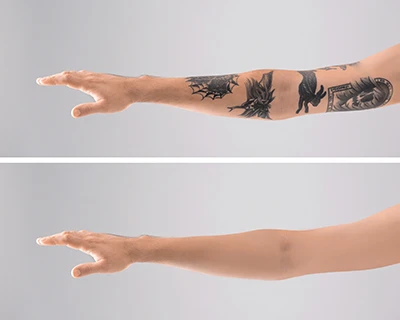
Laser tattoo removal is a treatment that uses focused light energy to break down tattoo ink within the skin. Rather than simply "erasing" the tattoo from the skin's surface, the laser targets ink particles deep within the skin, shattering them into smaller fragments.
Subsequently, the body's immune system gradually clears away these tiny ink particles through natural metabolic processes. This is why a tattoo fades over time rather than disappearing entirely after a single treatment.
Why Are Tattoos Difficult To Remove?
During the tattooing process, ink is injected deep into the dermis-a layer of the skin. Although the immune system attempts to eliminate the ink, the particles are typically too large and chemically stable to be removed, causing most of the pigment to remain in the skin. This is why tattoos can remain clearly visible for many years.
Laser treatment changes this. By breaking large ink particles into smaller fragments, the laser makes it easier for immune cells to process and remove them. For this reason, laser technology is widely recognized as the most effective method for those seeking to remove a tattoo.
Which Types of Lasers Are Effective for Tattoo Eraser?
In professional tattoo removal procedures, the following two types of lasers are commonly used:
Q-Switched Laser
Q-switched lasers emit energy pulses in the nanosecond range. They are capable of treating a wide variety of common tattoo ink colors, particularly black, dark blue, and red.
Due to their reliable performance and effectiveness across many types of tattoos, Q-switched lasers remain widely used in professional clinics today.
Picosecond Laser
Picosecond lasers emit pulses that are even shorter than those of Q-switched lasers. Because of this ultra-fast pulse speed, they can break down tattoo ink into much finer particles. Picosecond lasers are often more effective for colors that are difficult to remove or for tattoos that respond slowly to traditional laser technology.
While picosecond laser treatment is generally considered a more advanced option, the most appropriate approach should be determined based on factors such as the colors of the tattoo, skin type, the depth of the ink, and the specific treatment goals.
Which Colors Are the Hardest to Remove?
- Black ink is generally the easiest to remove.
- Dark blue ink also typically responds well to removal efforts.
- Red and orange inks can also be treated effectively when the appropriate laser wavelength is used.
- Green, light blue, and teal inks are generally more difficult to remove.
- Yellow, white, and skin-toned inks are particularly challenging.
- In some cases, white or skin-toned inks may even darken following laser treatment due to the oxidation of the pigments.
For this reason, it is crucial to have an assessment by a professional before undergoing treatment.
If you are wondering whether laser treatment can remove colored tattoos, the answer is yes-though the outcome depends largely on the color, depth, and quality of the ink, as well as the specific laser technology employed.
What Actually Happens During a Laser Tattoo Removal Session?
Pre-treatment Preparation and Skin Assessment
- Medical Evaluation: A qualified practitioner will assess your skin tone (using the Fitzpatrick scale), medical history, and the specific characteristics of your tattoo (such as its age, ink density, and colors).
- Sun Protection: For at least 2–4 weeks prior to treatment, you should avoid direct sun exposure and refrain from using tanning beds or self-tanning products, as tanned skin increases the risk of burns and pigmentation issues.
Pain Management: Will it hurt?
- Sensation: Most patients describe the feeling as similar to being snapped quickly against the skin with a rubber band-a sensation that is generally well within the range of tolerance.
- Enhancing Comfort: Opting for advanced laser systems equipped with integrated cooling technology can significantly improve comfort and safety, while also helping to prevent skin burns.
Immediate Reaction: The "Frosting" Effect
Within milliseconds of the laser making contact with the skin, the treated area of the tattoo will take on an opaque, white appearance. This "frosting" typically fades within 15–30 minutes, after which the area may exhibit mild redness or swelling. These are normal reactions and will not interfere with your daily life or work.
Laser Surgery for Tattoo: Is It Actually Surgery?
Some people refer to the process as "laser tattoo removal surgery," but in the traditional sense, it is generally not considered "surgery." It typically does not involve making incisions in the skin or using a scalpel to remove tissue.
The term "laser surgery" is sometimes used simply because the procedure employs medical-grade laser equipment. However, depending on how the skin reacts, laser tattoo removal is generally classified as a non-invasive procedure.
It is important to note that the procedure must still be performed by a qualified professional. If used improperly, laser energy can cause damage to the skin.
Common Myths About Laser Tattoo Removal
Myth 1: Any tattoo can be removed in a single laser session.
Most tattoos require multiple sessions. While a single treatment might fade the ink, complete removal typically takes time.
Myth 2: Higher laser power yields better results.
Excessive energy can damage the skin. Effective treatment is not about maximizing power, but rather about selecting the appropriate
wavelength, pulse duration, spot size, and energy level.
Myth 3: All tattoo colors respond to laser treatment in the same way.
Different pigment colors absorb different laser wavelengths. Black ink is generally easier to remove, whereas green, blue, yellow, and white inks are more challenging.
Myth 4: Laser tattoo removal always results in scarring.
While there is a risk of scarring, it is not inevitable. Professional treatment and proper aftercare can help minimize this risk.
Myth 5: Freshly applied tattoos are easier to remove immediately.
New tattoos require time to heal before they can be removed. Attempting treatment too soon can exacerbate skin irritation and lead to complications.
Who is suitable for laser tattoo removal?
- Individuals with healthy skin in the area to be treated.
- Those who understand that multiple sessions may be required to achieve the desired results.
- Those with realistic expectations.
- Individuals capable of following post-treatment care instructions.
- Those seeking a safe method to remove or fade a tattoo.
Who is not suitable for laser tattoo removal?
- Individuals with skin infections or injuries in the area.
- Those who have had significant sun exposure recently.
- Individuals prone to developing abnormal scarring.
- Those currently using photosensitizing medications.
- Individuals who are pregnant or have certain underlying medical conditions.
* A professional consultation is the best way to determine whether this treatment is right for you.
Basic Post-Procedure Care
- Keep the affected area clean and dry.
- Avoid scratching or picking at scabs.
- Avoid sun exposure.
- Do not go swimming until the skin has completely healed.
- Avoid saunas or exposure to high-temperature environments.
- Use the recommended healing ointment, if prescribed.
- Follow the care regimen provided by your medical professional.
FAQ
Q: How does laser tattoo removal work?
A: Laser energy breaks down tattoo ink into smaller, powder-like particles, which the body's immune system then gradually clears away.
Q: Is laser tattoo removal painful?
A: Yes, but the pain is generally brief and manageable. Many people describe the sensation as being snapped by a rubber band against the skin.
Q: How many treatment sessions are required?
A: Most tattoos require multiple sessions. The exact number depends on the size, color, depth, and age of the tattoo, as well as your individual skin type.
Q: Can laser tattoo removal completely remove a tattoo?
A: Some tattoos can be removed almost entirely, while others may only fade. The final result depends on the ink color, its depth, and how your body responds to the treatment.
Q: Which tattoo colors are the most difficult to remove?
A: Green, blue, yellow, white, and skin-toned inks are generally more difficult to remove than black ink.
Q: Is laser tattoo removal safe?
A: When performed by a trained professional using appropriate laser settings and followed by proper aftercare, the procedure is generally safe.
Q: How long does recovery take?
A: Most skin-surface reactions typically resolve within a few days to two weeks. Following treatment, the tattoo may continue to fade over the subsequent weeks.
Q: Can I remove a tattoo myself at home?
A: Attempting to remove a tattoo at home is not recommended. It can lead to skin burns, scarring, infections, or unsatisfactory removal results. Having a professional perform laser tattoo removal is both safer and more effective.