




Tattooing has become a widespread form of personal expression in our daily lives, and with its growing popularity, the demand for tattoo removal is also on the rise. Whether you are a clinic owner looking to expand your service offerings, a medical aesthetics center seeking to introduce new treatments, or an individual consumer interested in purchasing a home-use device, the market offers a vast array of options-ranging from Q-switched to picosecond lasers, and from portable to floor-standing models. However, the question that concerns consumers most is the price of these laser tattoo removal devices.
This blog post examines the various factors that influence the price of laser tattoo removal equipment, enabling you to make an informed decision for your next purchase. We also address key questions often raised by medical aesthetics clinic managers and distributors-such as "What is the total cost of ownership?" and "How long does it take to achieve a return on investment?"-to help you invest with confidence and avoid common pitfalls faced by first-time buyers.
What Is Laser Tattoo Removal Machine?
Laser tattoo removal equipment is a type of medical aesthetic device that uses high-intensity, ultra-short pulse lasers to shatter tattoo ink into tiny particles; these particles are subsequently cleared away naturally by the body's immune system over the course of several weeks. The effectiveness of the laser lies in its ability to be tuned to a specific wavelength that precisely targets tattoo pigments in the skin without damaging the surrounding tissue.
Laser tattoo removal is a long-term process rather than a quick fix. Complete removal typically requires multiple sessions (commonly 6–12), spaced weeks apart, as each session only breaks down a portion of the ink. Factors such as the tattoo's size, color, and depth also influence the number of treatments required. Compared to traditional methods like surgical excision, laser tattoo removal is a non-invasive, safe procedure associated with minimal discomfort. With proper technique and aftercare, there is virtually no risk of scarring, making laser tattoo removal equipment highly favored by both professionals and consumers seeking to remove tattoos.
Common Types of Tattoo Removal Technologies on the Market
Not all "laser tattoo removal devices" utilize the same technology, yet technology is the primary factor determining both price and performance. Below are several mainstream technologies you will encounter in the medical aesthetics market, each with its own unique advantages and suitable applications.
| Technology Type | Pulse | Principle | Tattoo colors | Advantage | Relative cost |
| Basic Nd:YAG | Nanosecond | photothermal effect | Light and dark inks | Lowest price, simple structure, easy to use | ★ |
| Q-switched Nd:YAG | Nanosecond | photothermal effect | Excellent results on dark ink |
Mature and reliable, widely available, excellent value for money | ★★ |
| Picosecond laser | Picosecond | photoacoustic effect |
Broad-spectrum; effectively removes stubborn pigments |
Fewer treatment sessions, faster clearance, gentler on the skin |
★★★★ |
| Multi-wavelength combined |
Primarily nanosecond range |
/ | Covers a wide range of colors and skin tones | Supports multiple colors and skin tones, supports a wide range of services |
★★★ |
Picosecond Laser
Picosecond laser technology represents a relatively new, high-end advancement in the medical aesthetics industry and the next generation of laser tattoo removal. These lasers emit ultra-short pulses-in the picosecond range (one-trillionth of a second)-relying primarily on the photoacoustic effect rather than the photothermal effect. By shattering ink into finer particles, picosecond lasers often require fewer treatment sessions to clear tattoos; they are more effective at treating stubborn colors like blue and green and are gentler on the surrounding skin.
The trade-off is the high cost-typically 4 to 10 times that of Q-switched laser systems. Clinics must recoup this investment through higher pricing or high patient volume, making these systems best suited for high-traffic, premium-positioned facilities.
Q-Switched Nd:YAG Laser
Q-Switched Nd:YAG laser systems have long been the workhorse of the tattoo removal industry and remain the most cost-effective choice for many buyers. These lasers utilize high-intensity nanosecond pulses to shatter ink via the photothermal effect. Common wavelengths include 1064 nm and 532 nm, which effectively remove dark, red, and orange inks; high-end models may add 585 nm and 650 nm wavelengths to cover a broader color spectrum. Q-Switched Nd:YAG technology is mature and reliable, with equipment that is widely available and affordably priced, offering excellent results for black and dark-colored inks.
However, its limitations include the need for more treatment sessions compared to picosecond lasers, as well as slightly lower efficacy in treating stubborn colors (such as blue and green) and extremely fine ink particles.
Basic Nd:YAG Laser
The most economical entry-level technology, commonly found in compact or handheld portable units, typically featuring a single 1064 nm wavelength. With a simple structure, the lowest price point, and ease of use, it is suitable for low-risk scenarios or permanent makeup (PMU) touch-ups.
However, its power, durability, and after-sales support are limited, and its color coverage is narrow; it is not recommended as a clinic's primary machine but rather serves better for testing the market or as a supplementary device.
Multi-Wavelength Technology
This involves integrating multiple wavelengths into a Q-switched or picosecond platform, or combining Nd:YAG capabilities with functions like SHR hair removal and RF skin treatments. A greater number of wavelengths allows for the treatment of a wider range of ink colors and skin types, offering maximum versatility. Multifunctional models also enable clinics to monetize multiple services with a single device, thereby increasing equipment utilization. However, these units come at a higher price point than single-wavelength models and require more complex operation and training.
Basic Nd:YAG meets needs for superficial or dark inks at the lowest cost; Q-switched Nd:YAG delivers reliable results at a moderate cost; multi-wavelength technology offers superior versatility; and picosecond technology commands the highest price in exchange for the fastest clearance and broadest color coverage. When purchasing a laser tattoo removal device for your clinic, prioritize factors such as tattoo colors, skin types, client demographics, patient volume, and budget, rather than marketing rhetoric.
Tattoo Removal Laser Machine Price Across Different Tiers
If you have started inquiring about laser tattoo removal equipment, you have likely encountered a frustrating issue: the quotes vary wildly. Some suppliers quote a few hundred dollars, while others quote $300,000-the price disparity is staggering. Based on budget and market positioning, laser tattoo removal devices can generally be categorized as follows.
| Tier | Typical Price (USD) | Mainstream Technologies | Target Use Cases |
| Entry-level | 200–10,000 | Standard Nd:YAG; Q-switched (desktop or floor-standing models) | Small studios, small clinics, and those testing the market |
| Mid-range | 3,000–100,000 | Multifunctional systems; dedicated Q-switched devices | Growing clinics, medical aesthetic spas, and dermatology practices with a steady client base |
| High-end | 80,000–300,000+ | Picosecond systems (Newangie, PicoSure, Candela, etc.) | High-traffic clinics, full-color ink capabilities, and high-end brand positioning |
Want to know the price of professional picosecond laser tattoo removal equipment? Please read: "How Much Does A Picosecond Laser Machine For Tattoo Removal & Skin Rejuvenation Cost?"
Regarding tattoo removal technology, there is a price difference between Q-switched laser equipment and picosecond laser equipment; for details, please see: "How Much Does Q-switched Laser Tattoo Removal Equipment Cost?"

Factors Influencing the Pricing of Laser Tattoo Removal Machines
There are many factors that affect the price of laser tattoo removal equipment. Once you understand why there can be a price difference of tens of thousands of dollars between two machines in the same category, you can identify reasonable pricing and avoid overspending. Here are the primary cost drivers:
🔹Laser Technology
The more advanced the technology, the higher the price of the tattoo removal equipment. Picosecond systems are 4–10 times more expensive than Q-switched Nd:YAG systems due to the advanced engineering required to generate ultra-short pulses. Features such as multiple wavelengths and advanced cooling systems also increase the cost.
🔹Number of Wavelengths
Single-wavelength machines (e.g., 1064 nm only) are cheaper but can only treat dark ink. Multi-wavelength systems cover a wider range of ink colors, expanding your potential client base-and consequently, commanding a higher price.
🔹Peak Power and Spot Size
Higher peak power and adjustable spot sizes mean faster treatments and greater effectiveness across a wider variety of tattoo types, resulting in a higher price point.
🔹Brand and Reputation
Well-known brands like Newangie often charge higher prices due to their reliability, superior warranties, lower failure rates, and responsive after-sales service. When you buy from Newangie, you are purchasing more than just a machine; you are getting comprehensive free product training, OEM/ODM services, marketing support, and robust after-sales care. Clinics, beauty salons, and distributors should look beyond immediate gains and prioritize long-term profitability.

🔹FDA/CE Certification and Compliance
Certified machines have a higher upfront cost but reduce liability and legal risks. A low-priced, uncertified tattoo removal device can turn into a costly mistake.
🔹Device Features
Integrated cooling (enhancing patient comfort), safety interlocks, intuitive interfaces, and durable handpieces all add to the cost-and the value-of the equipment.
🔹After-sales Service, Warranty, and Training
Comprehensive warranties, hands-on training, and rapid technical support justify a higher price by minimizing your long-term risks and equipment downtime.
🔹New vs. Used Tattoo Removal Machines
A new machine costs more but offers the latest technology, a full warranty, and a longer lifespan;
a used one saves money but may come with limited warranty coverage and higher maintenance risks.
Q-Switched vs. Picosecond: Which Should I Buy?
| Comparison Criteria | Q-switched Nd:YAG laser | Picosecond laser |
| Initial Investment (USD) | 1,500–100,000 | 80,000–300,000 |
| Treatment Sessions | Higher | Lower |
| Ink Colors | Good (best for dark colors) | Broader (includes stubborn colors) |
| Gentleness on the Skin | Good | Generally gentler |
| Suitable for Customer Volume | Low to moderate patient volume | Moderate to high patient volume |
A picosecond laser system is cost-effective only if you can recoup the higher investment-either by charging a premium for faster results or by leveraging high patient volume to capitalize on the efficiency of each treatment session.
For newly opened clinics or those with low patient volume, it is generally better to start with a high-quality Q-switched Nd:YAG laser and upgrade to a picosecond laser for tattoo removal later.
NOTE: Base your choice on your specific patient demographics (ink colors and skin types), patient volume, and budget, rather than simply on which technology sounds more advanced.
Hidden Costs No One Tells You About
The price of the machine itself is just the beginning; a series of subsequent expenses must also be factored into the total cost. These hidden costs associated with laser tattoo removal equipment are frequently cited as major pain points by practitioners in online forums and medical aesthetics communities.
- Consumables
Dressings, cleaning supplies, topical anesthetic creams, and protective eyewear. While the cost per treatment is low, these expenses add up quickly with high patient volume.
- Handpiece Replacement
Practitioners have reported replacement costs for lasers or handpieces reaching thousands of dollars. Therefore, always ask the manufacturer about component lifespan and replacement costs before purchasing.
- Maintenance and Calibration
Regular maintenance and calibration ensure consistent results and safer operation. Companies like Newangie, for instance, offer a two-year warranty and free lifetime technical support.
- Downtime Risks
If the machine breaks down, it means lost revenue. The availability of spare parts and repair turnaround times directly impact your earnings. Manufacturers that provide prompt after-sales service and quick solutions are particularly reliable.
- Training and Certification
Staff training, operating licenses (requirements vary by region), and liability insurance.
- Facility and Safety
Treatment room setup, ventilation, and safety compliance requirements.
Brand-New vs. Pre-Owned Laser Tattoo Removal Devices
For budget-conscious buyers, one of the most critical decisions is whether to purchase a new or pre-owned tattoo removal device.
Purchasing Brand-New Tattoo Removal Equipment
- Pros: Latest technology, full manufacturer warranty, longest lifespan, comprehensive training and support, and top-tier safety and compliance certifications.
- Cons: Highest upfront cost.
- Best for: Established clinics or buyers prioritizing maximum reliability and resale value.
Purchasing Pre-Owned or Refurbished Equipment
- Pros: Significant cost savings-for example, a pre-owned picosecond tattoo removal device typically costs $50,000–85,000, far below the price of a new unit; allows access to high-end technology at a lower entry point.
- Cons: Limited or no warranty, unclear service history, potentially higher maintenance costs, and possible difficulty finding parts for older models.
- Key checks before buying pre-owned: Maintenance and repair records, remaining warranty (if any), pulse count and remaining lifespan of the handpiece/laser, parts availability, and whether the seller offers support or a return guarantee.
- Best for: Expanding clinics seeking professional-grade capabilities on a tighter budget-provided they are willing to conduct thorough due diligence.
Newangie Picosecond Laser Tattoo Removal Equipment for Sale
Newangie provides professional tattoo removal equipment to distributors and various medical aesthetic facilities-including clinics, beauty salons, and spas-across the globe.

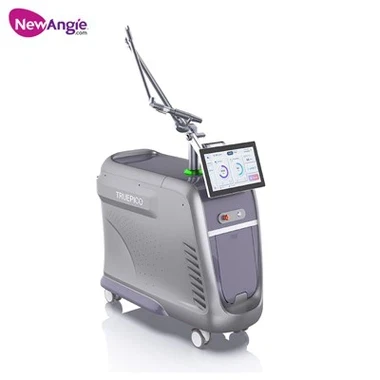
350Ps True Pico Laser Tattoo Removal Machine
Featuring 350ps ultra-short pulses and 1.43GW peak power, it effectively shatters deep-seated, stubborn pigment from the very first treatment; dual wavelengths of 1064nm/532nm (with optional 585/650nm) cover the full color spectrum, including green and sky blue.
The 2–10mm handpiece allows for direct spot size adjustment, enabling faster treatment of large areas.
A Korean-imported 7-joint articulated arm ensures 360° rotation with zero energy loss and stable output.
A single device handles tattoo removal, pigmentation treatment, and skin rejuvenation/anti-aging.
Ideal for: Clinics, beauty salons, and spas seeking a single, high-performance "true picosecond" platform to cover multiple treatment needs.
PicoSmart Pico & Nano Pico Laser Machine
Features an exclusive dual-mode fusion of 350ps picosecond and 2ns nanosecond technologies: nanosecond pulses first shatter large pigment particles, followed by picosecond pulses that "pulverize" them into fine dust-all within a single session.
The 755nm wavelength specifically targets stubborn blue and green pigments, reducing the required treatment course from 12 sessions to 6 while minimizing discomfort; it is safe even for darker skin tones, with precision settings as fine as 0.01 J/cm².
A high 10Hz frequency compresses treatment time to just 10–15 minutes, while also enabling high-margin services such as skin rejuvenation.
Ideal for: Established clinics and chain practices targeting the high-end market and seeking superior clearance rates across the full color spectrum.

Pico Laser Tattoo Removal Machine
It utilizes 450ps picosecond technology (dual-wavelength 1064nm/532nm; 0.78GW) to efficiently shatter pigment and stimulate collagen regeneration with minimal thermal damage.
Treatments take just 15–30 minutes with a very short recovery period, allowing most clients to resume normal activities the same day.
Featuring core components imported from the US and an articulated arm imported from South Korea, the system ensures stable output and supports a wide range of treatments, including tattoo removal, spot removal, melasma treatment, skin rejuvenation, and anti-wrinkle therapy.
Ideal for: Clinics and aesthetic salons with limited budgets looking to quickly enter the picosecond treatment market.


Questions to ask any supplier before signing a contract
Does the machine have FDA/CE certification, and can documentation be provided?
What does the warranty cover, and what is its duration?
What is the cost of replacing the handpiece/laser, and what is its lifespan?
What is the typical turnaround time for repairs, and is a loaner unit provided?
Is training included, and does it involve hands-on practice?
Can references from existing users be provided?

This is a real "before-and-after" comparison of tattoo removal results shared on Instagram by an overseas medical aesthetics clinic. You can see that after five treatments with our laser tattoo removal equipment, the tattoo design has visibly faded and the ink has significantly diminished.
Conclusion
Prices for laser tattoo removal machines range from around $200 to over $300,000, with most professional-grade units falling between $20,000 and $100,000. However, the sticker price shouldn't be your primary concern. Savvy buyers focus on the total cost of ownership and return on investment: they align the laser technology with their actual client demographics, budget for consumables and maintenance, carefully evaluate pre-owned equipment, and select suppliers that offer genuine after-sales support.
With the right fit, tattoo removal can become one of the most profitable and fastest-paying-off services you add to your business. The machine is merely a tool-it is your business model that truly drives profitability.