



This year, an increasing number of aesthetic patients are moving away from results that look obviously "done" in favor of a natural, authentic skin appearance. This pursuit of natural beauty is reshaping the entire medical aesthetics industry, a trend most clearly evidenced by the surging popularity of "non-surgical face lift" treatments.
For decades, surgical facelifts were the only truly effective solution for sagging skin. However, surgery-which carries risks and often results in facial swelling or an overly tight, unnatural look-no longer aligns with the demands of today's consumers. They seek visible yet natural improvements combined with safety, cost-effectiveness, and minimal disruption to their daily lives. Non-surgical face lifts have emerged as the preferred alternative; they offer a gradual restoration of skin firmness and facial contours without the need for operating rooms, general anesthesia, or weeks of recovery time.
This article provides an in-depth analysis of the underlying technologies behind non-surgical face lifts and clarifies the often-confused distinction between "non-invasive" and "minimally invasive" procedures. It also references equipment from leading brands to serve as a guide for clinics dedicated to providing natural-looking aesthetic treatments.
Why do more people prefer non surgical face lift treatments?
Surgery vs. Non surgical facelift treatment: A Side-by-Side Comparison
| Factor | Traditional Facelift (Surgical) | Non-Surgical / Non-Invasive Options |
| Downtime | 2–4 weeks | 0–3 days |
| Anesthesia | General or deep sedation | None or topical numbing only |
| Scarring/Incisions | Yes | None (energy-based) or pinpoint marks (injectables) |
| Cost | High, one-time major investment | Lower per session, often repeated |
| Results | Dramatic, long-lasting (5–10+ years) | Subtle to moderate, requires maintenance (1–3 years) |
| Risk profile | Surgical risks (infection, anesthesia complications) | Minimal, treatment-specific risks |
Who is a suitable candidate for non surgical face lift treatments?
Non surgical facelift treatments are best suited for individuals aged 25 to 55 with mild to moderate facial laxity-such as early-stage nasolabial folds, a sagging jawline, drooping apple cheeks, or fine lines-rather than severe sagging characterized by significant structural collapse and altered facial contours.
For individuals with more advanced laxity, non surgical face lift treatments can still serve to delay the need for surgery or act as a supplementary measure for post-surgical maintenance.
Best Non-Surgical Facial Lifting Treatments For Your Clinic & Spa
I believe it is important to first clarify a distinction that is often blurred in marketing materials but is clinically significant:
- "Non-surgical" treatment is not synonymous with "non-invasive" therapy;
- Not all treatments marketed as "non-surgical" are truly "non-invasive."
Strictly speaking, the category of "non-surgical" encompasses both "non-invasive" and "minimally invasive" procedures, as injections do not require general anesthesia, incisions, or sutures. For the sake of convenience, these are often grouped together-distinct from surgical facelifts-under the umbrella of "non-surgical facial lifting."
Non-invasive: The treatment does not compromise the skin barrier; energy penetrates intact skin to target deep tissues without the use of needles or incisions.
Minimally invasive: The procedure requires penetrating the skin with a needle or fine cannula but does not involve surgical incisions, sutures, or general anesthesia.
| A True Non-Invasive Facelift

HIFU (High-Intensity Focused Ultrasound)
HIFU uses a transducer to focus high-frequency ultrasound waves (4–7 MHz) into precise thermal points, targeting the SMAS layer deep within the skin-the same connective tissue layer lifted and tightened by surgeons during traditional facelifts. The sound waves pass harmlessly through the epidermis and dermis to reach the target depth (1.5–4.5 mm), where they instantly heat the tissue to 60–70°C, leaving the skin surface completely intact throughout the procedure.
Advantages: It reaches the greatest depth among non-invasive therapies, addressing structural laxity that is difficult for other energy-based devices to treat in a single session; requires no incisions or needles.
Results: The controlled thermal injury at each coagulation point triggers the body's natural wound-healing response, subsequently stimulating new collagen production over 2–3 months for a gradual, natural lifting effect. It is considered the "gold standard" for non-invasively treating deep structural laxity, with results typically lasting 12–18 months.
RF (Radiofrequency Technology)
RF delivers alternating current through the skin, utilizing the tissue's natural resistance to convert electrical energy into heat, thereby evenly warming a broad area of the dermis. Monopolar systems provide deeper, more uniform heating, while bipolar/fractional systems concentrate energy more in the superficial layers. Built-in cooling mechanisms protect the epidermis while allowing the dermis to reach therapeutic temperatures of approximately 55–65°C.
Advantages
- Needle-free, comfortable treatment experience with virtually zero downtime;
- Suitable for a wider range of skin types compared to more aggressive energy-based devices;
- Can be combined with other therapies.
Results
Causes immediate contraction of existing collagen fibers while stimulating long-term new collagen production, delivering a dual "immediate plus long-lasting" effect; particularly effective for skin tightening and improving fine lines.
Laser Skin Rejuvenation
Utilizes multiple laser modes (including intraoral approaches) to remodel tissue through a dual-action process targeting both the inside of the mouth and the skin's surface.
Advantages
- The treatment process is very gentle and well-tolerated;
- It can be repeated frequently;
- It improves skin texture while addressing skin laxity.
Results
Delivers gradual tightening and smoothing rather than a single, aggressive intervention; it is better suited as a long-term, routine maintenance regimen than a one-off corrective treatment.
| Minimally Invasive Facial Lifting Treatment
Microneedle Radiofrequency (RF)
Microneedles penetrate the skin and deliver RF energy from their tips to heat specific points within the dermis, stimulating new collagen production while avoiding burns to the epidermis.
Advantages:
Improves both skin texture and mild skin laxity;
Needle depth can be adjusted based on the treatment area and specific needs.
Effects:
Stimulates the production of collagen and elastin to improve scars, tighten the skin, and reduce fine lines; due to the use of needles, it is technically classified as minimally invasive rather than non-invasive.

Hyaluronic Acid (HA) Fillers
Mechanism: Precise injection at key structural support points-such as the cheekbones, jawline, and temples-to restore lost subcutaneous volume.
Advantages:
Immediate results;
Highly customizable based on individual facial structure;
If the outcome is unsatisfactory, the effect can be reversed by dissolving the filler with hyaluronidase.
Effects:
Provides physical support to the overlying skin, resulting in a lifting effect; often referred to as a "liquid facelift," with results typically lasting 6–12 months.
Regenerative Injections
Unlike products that merely add volume, these stimulate the body's own collagen production over a period of weeks to months.
Advantages:
Results are more gradual and natural-looking than traditional fillers;
Longer-lasting effects;
Works by leveraging the body's natural regenerative mechanisms.
Effects:
Gradual improvement in skin firmness and volume, lasting up to 2 years; however, initial results are not as immediate as those from HA fillers.
Botulinum Toxin
Relaxes the platysma muscle (which pulls the jawline downward), allowing the upward-lifting muscle groups to become dominant.
Advantages:
Quick treatment with minimal discomfort;
Works by relaxing muscles rather than adding volume, making it complementary to fillers or energy-based devices.
Effects:
Visually achieves a subtle lift of the jawline; results typically last 3–4 months.
Non-Surgical Cheek Lift
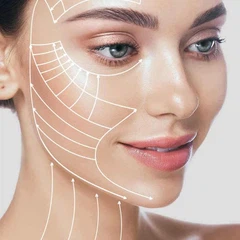
As we age, the "apple of the cheek" (malar fat pad) gradually atrophies and descends, while skin elasticity declines. This leads to flattened cheeks and deepened nasolabial folds, giving the face a tired, heavy appearance.
Treatment Approach:
First, dermal fillers or biostimulators are injected into the cheekbones and mid-face to restore lost structural support. Subsequently, HIFU or RF is used in the same area to tighten the skin, allowing it to drape naturally over the restored volume rather than appearing "puffy."
Expected Results:
Cheek contours appear fuller and lifted, nasolabial folds are visibly softened, and the overall complexion looks more refreshed and vibrant. Results typically emerge gradually over 2–4 weeks as swelling subsides and collagen remodeling takes place.
Non Surgical Lower Face Lift
A loss of structural support in the skin and subcutaneous tissue around the jawline leads to sagging and the formation of jowls. Simultaneously, the downward pull of the platysma muscle in the neck further blurs the boundary between the face and neck.
Treatment Approach:
First, RF or HIFU is applied to the jawline and upper neck to tighten the skin.
Next, fillers are precisely injected along the mandibular border to reshape a defined, continuous jawline. Finally, botulinum toxin is injected into the platysma muscle to relax its downward pull, allowing the upward-lifting muscle groups to become visually dominant.
Expected Results:
A more defined and continuous jawline, significant improvement in jowls, and a smoother transition between the face and neck.
Periocular and Brow Area
Skin thinning, laxity of the orbital retaining ligaments, and volume loss in the brow fat pads cause the tail of the brow to droop and overhang the upper eyelid. This creates a tired or heavy-lidded appearance-often one of the earliest signs of facial aging.
Treatment Approach:
Because the skin around the eyes is extremely thin and delicate, treatments in this area require lower energy settings and specialized, precision probes. Localized RF or micro-focused HIFU probes are applied to the area above and around the brow bone (never directly on the eyelid) to tighten the skin and lift the brow tail. Small amounts of botulinum toxin may also be injected to fine-tune the brow shape by relaxing the muscles that pull the brow downward.
Expected Results:
The eye area appears more relaxed and lifted, with a reduction in the heavy, hooded look of the brows, all while avoiding the "frozen" or "surprised" expressions often associated with surgical brow lifts.
Non Surgical Skin Lift for Neck
The neck is one of the first areas to develop wrinkles and is notoriously difficult to treat effectively with skincare products alone.
Treatment Approach:
RF and HIFU technologies can be used to tighten the platysma muscle and surface skin, while botulinum toxin injections help soften the appearance of horizontal neck lines.
Since neck skin is thinner than facial skin, practitioners typically use gentler settings and build results through multiple sessions rather than a single high-intensity treatment.
Expected Results:
The neck contour becomes firmer and more defined, harmonizing with the lifted facial features and avoiding the common visual disconnect where the face looks youthful while the neck reveals signs of aging.
How long do the results of non-surgical facial treatments last?
The duration of results varies by technique:
- Botulinum toxin: 3–4 months;
- Hyaluronic acid fillers: 6–12 months;
- HIFU and RF (relying on collagen remodeling): 12–18 months;
- Biostimulators: Up to 2 years.
No treatment can permanently halt aging; most patients require periodic maintenance sessions to sustain results rather than relying on a single treatment.
Are there side effects associated with non-invasive facial lifting?
Yes, though they are typically mild and temporary.
Energy-based treatments (HIFU, RF) may cause redness, swelling, or a stinging sensation lasting a few days; in rare cases of improper technique, nerve irritation or burns may occur.
Injectable treatments may result in bruising or swelling, with occasional instances of nodules or asymmetry.
Choosing a qualified, reputable facility can significantly reduce these risks.
How do you choose the right non-invasive facial lifting device?
Match the technology to the specific needs: choose HIFU for deep structural laxity, RF for gentle, overall tightening, and microneedling RF for improving skin texture and fine lines. Prioritize devices that are FDA/CE certified, backed by verifiable clinical data, and feature adjustable energy parameters; also, ensure the operator has received professional training on the specific device.
If you wish to offer safer and more effective non-invasive facial lifting treatments to your patients, please contact us for a free quote.
The market for non-surgical facial lifting has matured, increasingly centering on the consumer desire for results that look natural and subtle. Truly non-invasive technologies (such as HIFU and RF) act on deep tissues without compromising the skin barrier, whereas minimally invasive treatments utilize fine needles to achieve precise volume restoration and muscle modulation. Understanding this distinction goes beyond mere technical detail; it helps individuals form realistic expectations regarding recovery times, the longevity of results, and the capabilities of various treatment modalities.
For most people, optimal results are rarely achieved through a single treatment but rather through a combined approach: using energy-based devices to address skin laxity alongside targeted injections to replenish lost volume. Non-surgical facial lifting is not a substitute for surgery; instead, it represents a long-term investment in achieving gradual, natural-looking anti-aging results.