





Diet and exercise alone are often insufficient to eliminate stubborn, localized fat deposits. Even when weight is lost, issues like cellulite and skin laxity can prevent the body from appearing as toned as desired. In the realm of non-invasive body contouring, there are two primary energy-based approaches: radiofrequency (RF) and microwave technology (exemplified by ONDA Coolwaves).
The former focuses energy within the dermis, addressing skin laxity through collagen contraction and the stimulation of new collagen; however, achieving fat reduction typically requires a longer series of treatment sessions. The latter utilizes 2.45 GHz medical-grade microwaves, employing surface cooling to direct peak temperatures into the subcutaneous fat layer-a method that offers greater efficiency for treating larger areas and requires fewer sessions to achieve fat reduction.
This article compares the two technologies across four dimensions-mechanism, clinical outcomes, patient comfort, and cost-to assist both patients and clinics in making an informed choice.
2.45 GHz Microwave (Coolwave) VS. Radiofrequency (RF)
| Dimension | 2.45 GHz Microwave (Coolwave) | Radiofrequency (RF) |
| Energy Type | Microwave energy | Radiofrequency electromagnetic waves |
| Operating Frequency | 2.45 GHz | Approximately 0.3–40 MHz |
| Depth of Energy Penetration | Reaches the subcutaneous fat layer | Superficial dermis and the fibrous septal network |
| Duration per Treatment | 30–45 minutes (abdomen/flanks) | 30–45 minutes; longer for large-area, multi-zone treatments |
| Typical Course of Treatment | 2–4 sessions | 4–8 sessions, plus maintenance sessions |
| Treatment Interval | 2–4 weeks | 1–2 weeks |
| Sensation | Deep warmth, dull ache | Superficial heat; noticeable stinging/pricking at high energy levels |
| Surface Cooling | An integral part of the mechanism; failure of the cooling system poses a risk | Important, though the core mechanism does not rely on cooling |
| Dependence on Operator Technique | Moderate | High |
| Primary Desired Outcomes | Fat reduction, body contouring, improvement of cellulite | Skin tightening, wrinkle reduction, stimulation of collagen production, facial rejuvenation |
Dependence on operator technique
Radiofrequency (RF) treatments require a high level of proficiency regarding skin contact, movement speed, and the incremental adjustment of energy levels. Consequently, professional training for the therapist is essential; otherwise, the treatment results may prove unsatisfactory.
What is 2.45 GHz Microwave (Coolwave)?
Coolwave refers to a 2.45 GHz microwave-based body contouring technology. It is termed "cool microwave" because the treatment applicator continuously cools the epidermis during the procedure, drawing heat away from the superficial layers and shifting the peak temperature deeper into the subcutaneous fat.
When fat cells are exposed to a temperature of approximately 45°C for a sustained period, they undergo apoptosis (programmed cell death). Over the following weeks, these cells are cleared by macrophages, resulting in fat reduction and skin tightening, while also improving the appearance of cellulite and mild skin laxity.
Treatment Areas
Lower abdomen, flanks (love handles), inner and outer thighs, sub-gluteal area (under the buttocks), and upper arms.
Suitable Settings
Medical aesthetic clinics, dermatology practices, body-contouring chains, and mid-to-high-end comprehensive beauty salons.
NOTE: Because Coolwave results typically emerge gradually over 4–6 weeks, businesses that rely on a "single-session" experience to secure long-term clients may find that customers do not return after their first visit.
What is Radiofrequency (RF) Fat Reduction?
Radiofrequency (RF) is a non-invasive body contouring and fat-reduction technology. It delivers energy into the skin via a treatment probe, causing water molecules and charged particles within the tissue to move and rub against one another in response to the electrical current, which raises the local temperature.
As the temperature rises, collagen fibers contract and the production of new collagen is stimulated, leading to improved skin firmness-an effect that goes beyond simple fat reduction. Achieving actual fat reduction requires higher energy levels and a longer course of treatment.
What can it address?
Skin laxity, cellulite (dimpled skin texture), postpartum abdominal laxity, mild sagging in the face and neck, and localized fat deposits.
Treatment areas
RF is particularly effective for small-area, precision treatments, such as the upper arms, the area above the knees, and facial contours.
Suitable settings
Beauty salons, dermatology clinics, postpartum recovery centers, and rehabilitation facilities.
NOTE: RF equipment is available across a wide price range with a low barrier to entry, making it a common "first" energy-based treatment for new, independent clinics. However, it does have drawbacks: the improvement from a single session is modest, and the full treatment course is lengthy. Consequently, it is best suited for businesses that rely on repeat visits and membership-based revenue models.
Why 2.45GHz Microwave Targets Fat with Pinpoint Precision?
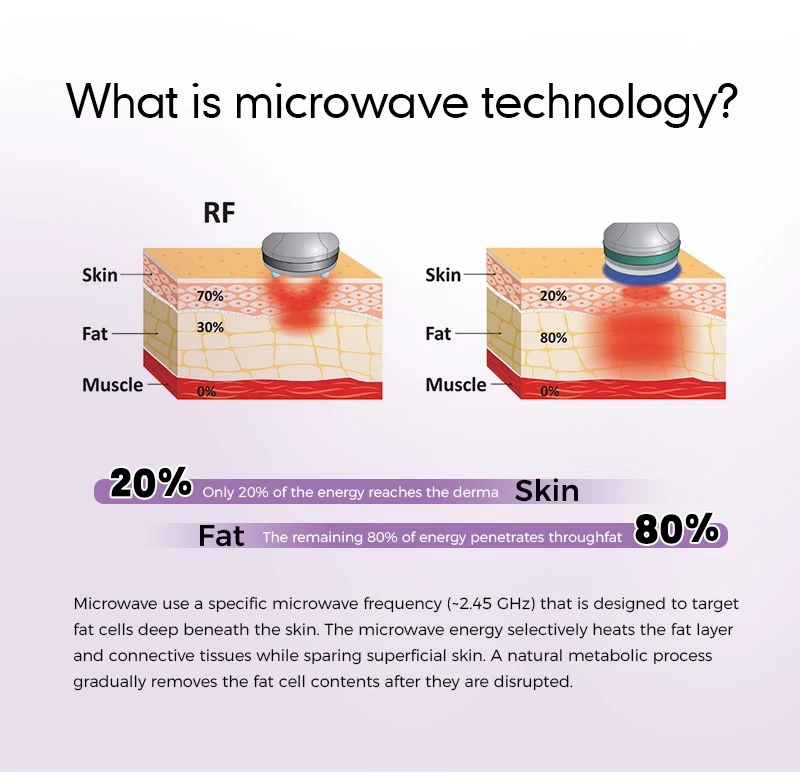
Cold microwave operates at a medical-grade 2.45GHz microwave frequency. Unlike RF, which generates heat through electrical current conduction, microwave energy acts directly on tissue as electromagnetic waves, with energy concentrated within the target fat layer. Its selectivity for adipose tissue is reported to be more than 3× that of conventional radiofrequency, based on manufacturer technical data.
The mechanism can be summarized as a "selective thermal effect": microwave energy heats fat cells to their apoptosis threshold, inducing programmed cell death. The apoptotic cells are then naturally metabolized and eliminated through the lymphatic system, permanently reducing the number of fat cells. This reaches a similar end point to cryolipolysis' "freeze-and-apoptosis" pathway, but through a different route.
In terms of efficiency, cold microwave achieves an energy utilization rate of 80%–94% (per manufacturer technical data), higher than conventional RF devices - meaning more effective fat reduction per unit of energy and more visible results per session.
Distinguishing Features of Cold Microwave
1. Three-in-one capability Combines fat reduction, skin tightening and cellulite improvement within a single treatment session - a combination offered by few non-invasive devices, to our knowledge based on published clinical data.
2. A dedicated 2.45GHz medical microwave frequency A distinctive technical pathway among fat reduction devices; reported selectivity for adipose tissue is over 3× that of conventional RF (manufacturer technical data).
3. Full-layer coverage in one platform Three applicator depths (3mm/7mm/15mm) cover the epidermis, dermis, superficial and deep fat layers.
4. Comfort-oriented design Maintains a constant epidermal temperature of 15–25°C throughout treatment via a real-time smart epidermal cooling system; most patients report that no anesthesia is required.
5. Zero consumables Applicators are reusable indefinitely, supporting low long-term operating costs for clinics.
Comparison of Comfort Levels
With Coolwave, the subjective sensation is one of deep, penetrating warmth. During focused treatment-particularly when the applicator is held in one spot for an extended period-a dull ache or a sore, distended feeling may occur. The epidermis is protected by a cooling mechanism; post-treatment, there is typically only mild redness, which usually subsides within one to two hours.
Radiofrequency (RF) treatment, by contrast, produces a sensation of superficial heat. As the energy level increases, a distinct, sharp, stinging sensation may be felt-this is especially pronounced near bony prominences (such as the anterior superior iliac spine or the rib cage). The epidermal temperature tends to be higher, leading to more noticeable post-treatment erythema. In some cases, minor edema may occur, which generally resolves within 24 hours.
The key difference lies in the nature of the risks: with RF, discomfort tends to develop gradually, allowing the practitioner to make timely adjustments based on the client's feedback. With Coolwave, the risks are less immediately apparent-a client might not feel pain right away even if the cooling system malfunctions-making rigorous equipment maintenance and routine self-check procedures critically important.
Comparison of Treatment Courses and Costs
| Procedure | 2.45 GHz Microwave (Coolwave) | Radiofrequency (RF) |
| Duration per session | 30–45 minutes | 30–45 minutes |
| Number of sessions | 2–4 sessions | 4–8 sessions |
| Total treatment duration | Approx. 1.5–3 hours | Approx. 3–6 hours |
| Interval between sessions | 2–4 weeks | 1–2 weeks |
| Consumables | Contact window, coupling agent | Coupling agent, electrode pads (for some models) |
| Personnel requirements | Moderate; highly standardized process | High; dependent on practitioner's technique and experience |
| Equipment cost | Relatively high | Wide range; low entry-level cost |
NOTE: When choosing between equipment based on two different technologies, clinics should also consider probe lifespan, replacement costs, and training expenses. The former factors affect operating costs over a three-to-five-year horizon, while the latter influence immediate clinical outcomes and the rate of patient complaints during the first three months.
Which techniques are suitable for different types of problems?
| Condition | Top Choices | Rationale |
| Localized fat deposits; skin elasticity remains decent | Microwave | Energy is delivered directly to the fat layer; requires fewer sessions |
| Primarily postpartum laxity; minimal excess fat | Radiofrequency | Focuses on collagen remodeling |
| Visible cellulite | Either method works; RF offers more direct tactile feedback | Targets microcirculation and fibrous septae |
| High body mass index (BMI); seeking weight loss | Neither is suitable | These devices are for body contouring, not weight loss |
| Both excess fat and skin laxity present | Microwave first, followed by RF | Reduce volume first, then address skin texture/quality |
Selecting Fat-Reduction Equipment for Your Clinic
Choosing Based on Your Target Clientele
When to Choose Coolwave?
- Stubborn fat in the abdominal/waist area, with decent skin elasticity.
- Sagging or poorly defined buttocks.
- Individuals focused on fitness and body contouring-those with thin fat layers but a desire for better definition.
When to Choose Radiofrequency (RF)?
- Postpartum abdominal laxity with minimal fat; the goal is skin tightening rather than volume reduction.
- Skin laxity following significant weight loss.
- Visible cellulite (dimpling) or poor skin texture.
- Areas such as the upper arms, the skin above the knees, the face, and the neck-where smaller applicators provide a better fit (unlike the larger applicators used for microwave-based treatments).
When Both Are Appropriate?
- Cases involving both excess fat and skin laxity: Address volume first, then skin texture, through a staged treatment plan.
- Clients over 40 with high repeat-visit potential: Use RF for recurring sessions and Coolwave for higher-ticket, premium treatments.
When Neither Is Appropriate?
Clients with a BMI of 28 or higher whose primary goal is weight loss: These devices are designed for body contouring, not weight reduction.
Choosing Based on Operational Conditions
| Scenario | Choice | Rationale |
| Single treatment room, limited budget, newly opened clinic | Radiofrequency (RF) | Low entry barrier; helps attract an initial client base; an 8-session treatment protocol also increases the frequency of client visits. |
| 3+ treatment rooms, higher average transaction value | Acquire both types | Allows for a larger client capacity and a more diverse range of services. |
| Chain clinics or distributor-led centralized procurement | Prioritize Coolwave; use RF as a foundational offering | Standardizes equipment and training, minimizing variations in treatment outcomes across different locations. |
| Client base primarily focused on fitness and body shaping | Prioritize Coolwave | Ideal for clients with thinner fat layers who are highly compliant and prioritize the number of sessions and recovery time. |
What Patients Should Expect: Sessions and Aftercare
• Session duration: 15–20 minutes per area; full-body multi-area contouring can be completed in under an hour - easily done over a lunch break.
• Recommended course: Typically 3–5 sessions per area, spaced 2–4 weeks apart; the final protocol should be determined by the treating physician.
• Treatment comfort: Cool and comfortable throughout, with a constant 15–25°C epidermal temperature and no anesthesia required for most patients.
• Downtime: Fully non-invasive - no redness, crusting or bruising; patients can return to work and social activities immediately, with zero downtime.
• Results timeline: Apoptotic fat cells are eliminated through the lymphatic system; results appear progressively over several weeks and then stabilize.
• Long-term results: The number of fat cells is permanently reduced; combined with a healthy diet and regular exercise, results are long-lasting and resistant to rebound.
Conclusion
Both cold microwave and radiofrequency (RF) technologies excel in their respective domains. Cold microwave technology integrates three distinct modalities, enabling full-depth treatment coverage; the procedure is comfortable, non-invasive, and requires no consumables. It serves as a versatile body-contouring solution rather than a mere replacement for any single existing technology.
For clinics, incorporating cold microwave technology allows for fat reduction, skin tightening, and the improvement of cellulite-all through a single device-while simultaneously lowering long-term operational costs. As a manufacturer specializing in R&D, production, and OEM/ODM customization, we provide CE/FDA-certified equipment solutions, backed by global after-sales support. Please contact us today to learn more.


