



An increase in body hair during pregnancy is a natural consequence of hormonal shifts. As levels of estrogen, progesterone, and androgens rise simultaneously, fine, soft vellus hairs-on the abdomen, face, around the areolae, and on the limbs-can become thicker and darker. Many expectant mothers consider laser hair removal as a permanent solution, but this raises several important questions:
Can pregnant women get laser hair removal?
Could the procedure harm the fetus?
Will the results of previous laser sessions be undone by the changes that occur during pregnancy?
This article explores the mechanisms behind laser hair removal and the reasons for increased hair growth during pregnancy to help you determine whether such treatments are appropriate. If they are not, what other options can expectant mothers turn to for help?
What Is Laser Hair Removal?
Laser hair removal is a medical aesthetic procedure that utilizes the principle of "selective photothermolysis" to destroy hair follicles. A laser with a specific wavelength penetrates the epidermis to reach the dermis, where the melanin in the hair follicles and hair shafts selectively absorbs the light energy and converts it into heat. This causes a rapid, localized rise in temperature, which destroys the germinative cells and stem cell tissue within the hair follicles, thereby inhibiting hair regrowth.
Common Wavelengths
- 755nm Alexandrite laser: Suitable for lighter skin tones and fine, soft hair.
- 808/810nm Diode laser: The clinical "gold standard," offering an optimal balance of safety and efficiency.
- 1064nm Nd:YAG laser: Features deeper penetration, making it suitable for darker skin tones.
Treatment Areas
Face (around the lips, jawline), torso (underarms, back, chest, and abdomen), limbs (arms, lower legs, thighs), and the bikini/intimate area.

Why do many pregnant women seek laser hair removal?
Hormonal stimulation leads to increased hair growth
- Prolonged growth cycle: During pregnancy, levels of estrogen, progesterone, and free androgens rise significantly. This extends the anagen phase of hair and delays the transition to the telogen phase.
- Increased pigmentation: Higher secretion of melanocyte-stimulating hormone (MSH) causes both new and existing body hair to become darker in color and coarser in texture.
A desire for comfort and hygiene
During pregnancy, a woman's basal body temperature rises, her metabolism accelerates, and there is a notable increase in vaginal discharge and perspiration. Dense body hair can trap moisture and heat, leading to unpleasant odors and making it more difficult to keep intimate areas and the underarms clean.
Preparation for childbirth and medical procedures
As the due date approaches, some pregnant women opt for hair removal in the perineal area. This can facilitate procedures such as an episiotomy or the suturing of tears during delivery, simplify postpartum care, and help reduce the risk of bacterial growth and infection.
Common areas of increased hair growth
The linea nigra (the vertical line on the abdomen), the area around the areolae, the skin around the lips (mouth), and the legs.
Do experts recommend laser hair removal when pregnancy?
The American Academy of Dermatology (AAD), the American College of Obstetricians and Gynecologists (ACOG), and major international clinical guidelines for energy-based medical aesthetic procedures all share a consistent position: any form of laser or intense pulsed light (IPL) hair removal is strictly contraindicated or not recommended during pregnancy.
To date, no clinical trials involving laser treatments for pregnant women have been-or can be-conducted globally; consequently, there is a lack of evidence-based medical data to confirm that such procedures are entirely safe for the fetus.
Furthermore, laser hair removal is an elective, non-urgent cosmetic procedure with no medical necessity for the mother's health. Given that risks cannot be entirely ruled out, most medical experts advise a cautious approach.
Moreover, the official clinical operation manuals and the regulatory registration documents (approved by the FDA or NMPA) for mainstream laser hair removal devices-such as those from the brand Newangie-explicitly list "pregnancy" as either an absolute or relative contraindication.
Risks of Laser Hair Removal During Pregnancy
Pigmentary Disorders
During pregnancy, melanocytes are in a state of heightened sensitivity and hyperactivity. This significantly increases the risk of severe post-inflammatory hyperpigmentation (PIH) and can exacerbate melasma on the face and body.
Uterine Contractions (Stress Response)
Increased blood volume leads to heightened sensitivity of nerve endings and a significantly lower pain threshold. The pain associated with the procedure, combined with emotional stress, can trigger sympathetic nervous system activation, potentially inducing reflex contractions of the uterine smooth muscle.
Transdermal Absorption of Agents
The percutaneous absorption rate of topical anesthetics (applied before the procedure) increases during pregnancy. These anesthetic agents may cross the placental barrier, posing potential toxicity to the fetal cardiovascular and nervous systems.
Impaired Barrier Repair
Immune function is often reduced during pregnancy, and the skin's ability to repair itself is weakened. This can lead to prolonged post-procedural edema and erythema, as well as an increased risk of folliculitis and superficial bacterial infections.
Reduced Treatment Efficacy
Hormonal fluctuations disrupt the hair follicle growth cycle. Follicles that are not in the active growth phase cannot be effectively inactivated by laser treatment, rendering the sessions ineffective and resulting in a waste of resources.
Alternative Options for Safe Hair Removal During Pregnancy
1. Recommended Safe Methods
Manual Safety Razor
Method: Using a mild shaving foam, shave the hair shafts along the direction of hair growth at the skin's surface.
Advantages: Provides immediate, thorough cleanliness; is low-cost and easy to use; acts only on the outer layer of the skin without damaging hair follicles, making it absolutely safe for both mother and baby.
Electric Shaver
Method: Use the built-in safety blade guard to trim hair quickly while hugging the skin.
Advantages: The blades do not come into direct contact with the skin, eliminating the risk of cuts; operation is fast and efficient, making it particularly suitable for safe grooming of large areas or areas with limited visibility.
Medical Round-Tip Trimming Scissors
Method: Use blunt-tipped safety scissors to trim hair close to the root.
Advantages: Zero tugging, zero irritation; suitable for precise trimming of scattered hair on sensitive areas such as around the areola and on the face.
2. Other Hair Removal Methods Explicitly Prohibited During Pregnancy
- Chemical Depilatory Creams: Contain strongly alkaline chemical solvents, posing an extremely high risk of contact dermatitis.
- Waxing/Mechanical Hair Removal: The forceful mechanical pulling causes severe pain, can easily trigger stress-induced uterine contractions, and is highly likely to tear hair follicles, leading to secondary infections.
- Home-Use IPL Devices: These pose risks of photothermal radiation and hyperpigmentation; official instructions list them as absolutely contraindicated during pregnancy.
- Electrolysis: Highly invasive and extremely painful; the transmission of microcurrents carries a risk of electrophysiological interference; strictly prohibited.

How long after childbirth can I undergo laser hair removal?
Women who had a vaginal delivery (at least 3 months postpartum):
Laser hair removal can be performed under the guidance of a professional once the pelvic floor muscles and birth canal injuries have fully healed and physical strength has largely recovered.
For those who had a cesarean section (at least 6 months postpartum):
Ensure that the incisions in all layers of the abdominal wall and the deep uterine scar have completely healed. If hair removal involves the abdominal or bikini areas, extra caution is advised; consult a medical professional and proceed with laser treatment only after receiving their approval.
Can pregnancy cause hair to regrow after laser hair removal?
The term "hair regrowth" here does not refer to previously removed hair "coming back to life," but rather to the possibility of stimulating the growth of "new hair" that was previously dormant.
Why isn't it "coming back to life"?
Hair follicles that have been completely destroyed by laser treatment undergo irreversible necrosis and will absolutely never grow hair again.
Why does it feel like "hair is growing back"?
There are large numbers of invisible, fine vellus hairs beneath the skin. During pregnancy, surges in estrogen and androgen levels activate these previously dormant tiny hair follicles, causing them to thicken, darken, and grow into visible new body hair-creating the illusion of "hair regrowth."
What happens after giving birth?
Most of it will fall out on its own: Within 6–12 months after childbirth, as hormone levels stabilize, most of this temporarily stimulated hair growth will naturally shed, and the skin will return to normal.
Very few strands remain-just a touch-up is needed: If a small amount of hair remains after childbirth, there's no need for a full treatment course; simply visit the clinic for 1–2 maintenance sessions.
Translated with DeepL.com (free version)
Is laser hair removal safe during breastfeeding?
It is permissible, provided that strict guidelines regarding treatment areas and the use of topical agents are followed.
Laser treatment involves non-ionizing physical light radiation. The light energy penetrates only as far as the hair follicles in the superficial dermis; it does not enter the systemic circulation or pass into breast milk. Consequently, it has no direct adverse effects on the composition of breast milk, lactation function, or the infant's health.
Precautions for laser hair removal while breastfeeding
- Strictly avoid the chest area: Laser treatment must never be performed on the breasts, areolae, or surrounding chest tissue, as the light and heat could trigger local inflammation or interfere with the mammary glands.
- Do not use topical anesthetics over large areas: This prevents anesthetic agents from being absorbed through the skin and entering the breast milk. It is recommended to use devices that employ purely physical cooling methods, such as sapphire contact cooling or air-cooling systems.
- Focus on peripheral areas: Treatment should be strictly limited to areas far removed from the mammary glands, such as the limbs or underarms.
Newangie NLD01: A Medical-Grade 808nm Hair Removal Platform Tailored for Postpartum and Lactating Clients
The lactation period is not a contraindication for hair removal; however, it demands an exceptionally high safety margin. The process requires precise energy control to prevent hyperpigmentation, physical cooling mechanisms to replace topical anesthetics, and the capability for targeted, localized treatment. The Newangie NLD01 medical-grade 808nm diode laser hair removal system is specifically engineered to address these requirements.
1200W Coherent Light Engine + 808nm Wavelength: With a penetration depth of 2–4mm, the laser reaches the growth center of the hair follicle. Visible results-such as hair curling and shedding-can be observed after a single session, effectively reducing the cumulative thermal load associated with multiple treatments.
Dual-Core Cooling (Compressor + TEC) System: The system begins frosting immediately upon activation. By utilizing pure, deep-tissue physical cooling instead of topical anesthetics, it eliminates the risk of anesthetic agents being absorbed through the skin during lactation.
AI-Powered Skin and Hair Analysis: The system measures melanin concentration in real-time and automatically calibrates parameters. It accommodates all skin types (Fitzpatrick I–VI), eliminating human error-such as relying on an operator's subjective judgment to set energy levels.
Magnetic Interchangeable Spot Sizes: The Ø6mm micro-spot allows for precise treatment around delicate areas (such as the borders of the areola), while larger spot sizes are ideal for rapid, gliding treatment over larger areas like the limbs or underarms.
Digital Patient Record Management Ecosystem: A 15.6-inch FHD smart terminal houses a compliant patient medical record database, systematically tracking the evolution of energy parameters and treatment efficacy across multiple sessions.
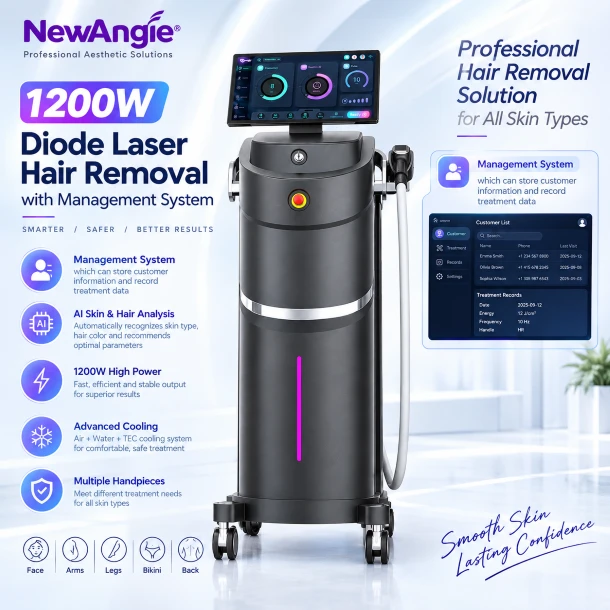
For clinics, the NLD01 condenses a full-body treatment session into approximately 20 minutes. Its AI-powered anti-burn mechanism significantly lowers the learning curve for new operators. For distributors, the device is fully compliant with FDA (US) and MDR (EU) standards, and is available for OEM/ODM customization at direct-from-factory pricing.
Important Precondition: No device can override the medical contraindication that prohibits laser hair removal during pregnancy. The NLD01 is intended for postpartum and breastfeeding individuals who have already given birth and are eligible for treatment; in all cases, a physician must assess the patient's hormone levels and skin condition prior to the procedure.